Chair Pose at a glance
Sanskrit: Utkatasana (utkata = fierce, strong, powerful, asana = pose)
Also called: Fierce Pose, Awkward Chair
Pose type: standing squat, a strengthening pose
Works: the fronts of the thighs, the muscles that support the knee, and the low belly
Opens: the chest, when your hands come together in front of your heart
Props that help: a folded blanket under the heels, a block between the thighs
Fierce, not chair
Chair Pose, Utkatasana, actually isn’t a direct translation from the Sanskrit. Utkata means strong or fierce or powerful or determined. So it doesn’t mean chair. But you can definitely see why it’s called Chair Pose: you’re sitting back into an invisible chair. I also like to imagine it’s called difficult pose, because it’s very obvious why. If you spend any amount of time in this pose, you can feel the burn.
There’s more going on here than strength, though. Chair Pose bends three joints at once, your hips, your knees and your ankles, and those are tricky joints for many people. Everyone has a different range of motion in each of them, whether that comes from arthritis or simply from the bone structure you were born with. So many people find it difficult to go deep in Chair Pose, and that’s okay. Most of what follows is about finding your own version of it: your own stance, your own neutral pelvis, your own arms.
Chair Pose, easy pose, difficult pose. Definitely not Easy Pose anymore.
Good for your knees
One really cool thing about poses like Chair Pose, the Warrior poses, lunges, anything that’s like a squatting position, is that you’re working the muscles that support the knee joint. When you strengthen the quadriceps, and all of the muscles that work to hold the kneecap in place on the leg, this is really good and healthy for your knees.
If the muscles around the knee joint are weak, everything tends to be a little bit more flexible. You could more easily twist your knee, or bring your kneecap out of position, and that strains the tendons, ligaments and connective tissues that support this area of the body. So yoga is really awesome for the knees in that way.
How to come into Chair Pose
There are two ways to set up for Chair Pose: from Mountain Pose, or from a Standing Forward Fold. Here’s the way in from Mountain Pose.
- Set your feetStand with your feet hip distance apart, toes pointing in whatever direction feels natural, or feet together if that’s your neutral.
- Find your foot lockSpread your toes out wide and find your foot lock, with the arches lifted.
- Reach upInhale and reach your arms up and overhead, letting your shoulder blades lift with them.
- Lift through the fingersLift up through your ring fingers and pinky fingers, from your waistline all the way up.
- Sit backExhale and bend your knees, letting your hips go back and your knees come forward, as if you’re sitting back into your imaginary chair.
- Match your pelvisFind the same tilt of your pelvis you had in Mountain Pose, and pull your low belly up and in.
- Breathe and sinkKeep your head in line with your spine and breathe. Inhale, reach up through your fingertips. Exhale, sink a little deeper into your hips.
From a Standing Forward Fold, bend your knees, sink your hips, and inhale your arms up and overhead. The two poses go hand in hand in Surya Namaskar B, where you inhale up into Chair Pose and exhale down into a forward fold, or the other way around. To come out, either fold forward like that, or press into your feet, straighten your legs and come back up to Mountain Pose.
Setting up your Chair Pose
Work from the ground up: feet, knees, ankles, pelvis, then the upper body. Each piece changes the one above it.
Your feet
The first thing to really examine are the feet. The traditional cue was to bring the feet together, big-toe mounds touching, inner ankles touching. For many people this is not their neutral standing position, and for some it creates a very big bowing effect in the legs.
Standing with your feet hip distance apart and your toes pointing in whatever direction feels natural often creates a more neutral base. For a lot of people that means the toes point off to the sides just a little bit, and the legs move from a bow-legged position into a straighter line. But it’s totally up to you. Feet together, feet hip distance apart, or even a little wider than hip distance if you want a more stable feeling in your lower body.
If your low back rounds in Chair Pose, try turning your toes in a little to create more space in your low back. If you have a bigger belly, the opposite often feels better: point your toes out to the side a little more and let your knees follow them, so there’s room for your belly.
Your knees
Bend your knees and let your hips go back. Your knees will come forward, and they will definitely come forward of your ankles.
There was this whole myth in yoga for a very long time that your knees aren’t allowed to go past your ankle joints. In Chair Pose it’s actually challenging to keep your knees in line with your ankles, and it’s perfectly fine for them to come forward of that vertical line. The standard thinking was to avoid putting pressure on the connective tissues at the front of the kneecap. But you stress these tissues all the time, walking up and down the stairs, going for hikes, riding your bike. These tissues need stress.
It’s perfectly fine for your knees to come forward of your ankles in Chair Pose.
Your ankles
Some people have more range of motion in their ankle joints than others, more ability to bring the shin forward toward the toes. For some people a deep angle in the ankle is very difficult, and that affects the whole pose: how far your knees can bend, and probably what your pelvis does too.
So pay attention to how much of a bend you get in your ankles and in your knees, and how that is affecting your hips. If your heels want to lift, or the ankle angle is clearly what stops you, a blanket under your heels changes the pose completely (you’ll find it in the options below).
Your pelvis
Imagine your pelvis as a bowl. In Mountain Pose you find your neutral, and that looks different for different people. For one person the bowl is perfectly level, for another it tips forward a little bit, and for someone else it tips back a little bit. Whatever your neutral is, that’s the same tilt you want to keep in Chair Pose.
When you first sit back, your pelvis will often tip forward. That’s totally fine. Just look for the same angle you had in Mountain Pose. Here’s what not to do. Tucking your tailbone under toward your kneecaps creates a horrible sensation. Popping your booty all the way back and widening your sitting bones behind you is the other extreme. You don’t want either of these. Find your neutral.
Notice the natural curve in your low back. It might even look a bit more exaggerated in Chair Pose, and that’s totally fine. Pull your low belly up and in to support the area, so the low back stays integrated and active.

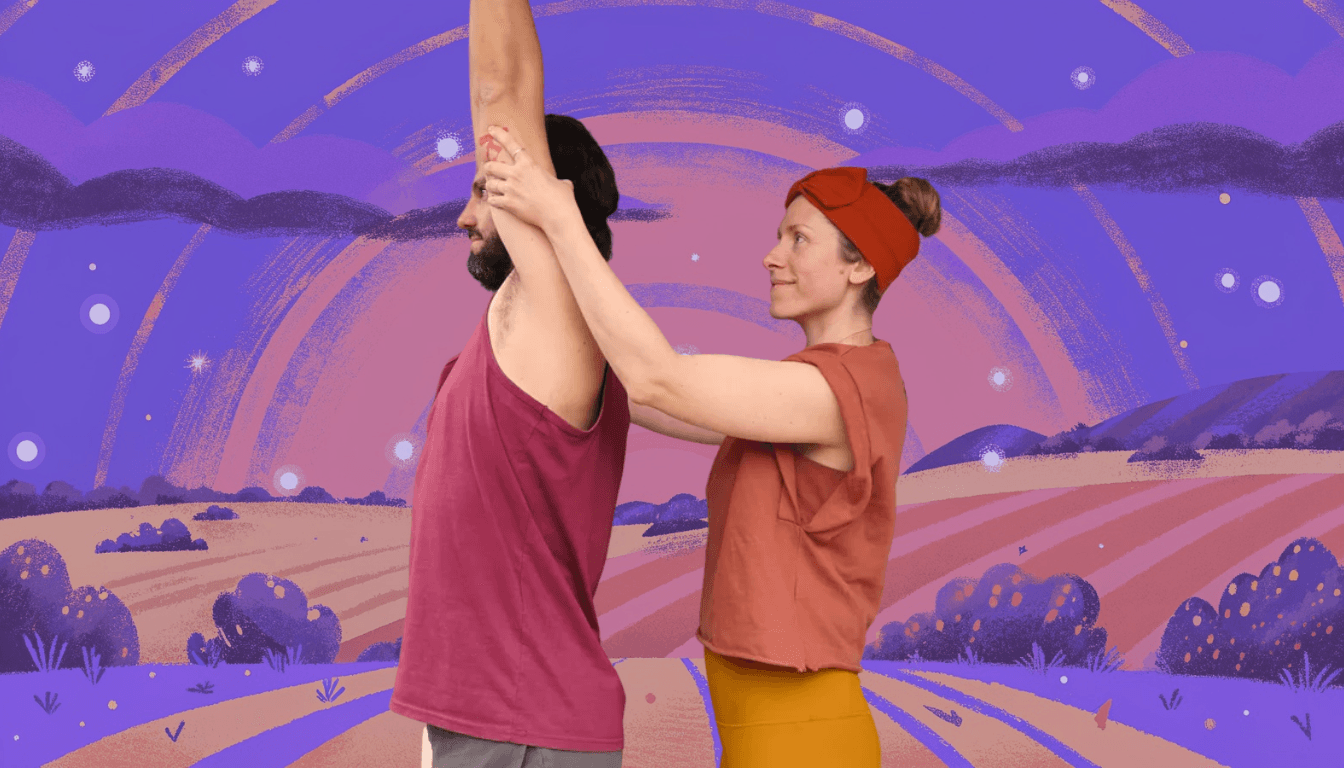
From the side: hips back, knees forward of the ankles, and the arms reaching up in line with the torso.
Your arms and shoulders
As you reach your arms up, let your shoulder blades lift with them. So don’t pull the shoulder blades down your back, let everything naturally lift up. Your hands are active, but half soft, like 50-50. Not dead fish, but not weird mittens either.
From there, imagine lifting up through your ring fingers and pinky fingers, from your waistline all the way up. Keep all of that, and then sit back into your chair.
Your chest
If your shoulders are tight, the tendency is to not reach your arms very far overhead, and maybe even to curl inward through the chest. If you can’t bring your arms all the way up, that’s totally fine. You can keep them a little forward, as long as you’re not straining and your back isn’t rounding because of it.
If there’s any extra strain, bring your hands together in front of your heart in Anjali Mudra. Lift your sternum up to the sky, broaden your collarbones and your shoulders apart from each other, and then sit a little bit deeper in your chair while you keep all of those actions in your upper body. This creates openness in the chest. We’re here to relieve tension and stress in the body, not to create more of it.
The most important part of Chair Pose is the natural curve of your spine, not where your arms are.
Your head and neck
A lot of times in Chair Pose the chin drops down to the chest. It’s not a huge risk or a horrible thing to do, but I like to bring this mindfulness into every single pose: keep your head and neck in neutral, in line with your spine.
Especially in this age we live in, many people walk around with the head way too far forward. If you can notice what you’re doing with your head in every pose, you can bring that same observation into your daily life, walking around the world, going to the grocery store. It’s really healthy for your upper back and your neck. And you will say hello to more people.
What Chair Pose works
Chair Pose is mostly a strengthening pose. The fronts of your thighs hold the deep bend in the knees, and they work more the deeper your hips go. Around them, the muscles that hold the kneecap in place work to keep the knee steady. Your low belly draws up and in to support your low back, and your shoulders work to hold your arms up.
You don’t need to sit all the way down to get the benefit, though. Imagine a chair behind you and sit toward it. Coming to around parallel to the floor, or slightly below, is plenty. I rarely go deeper than that myself, and if your joints only feel good a little higher, stay a little higher.
Chair Pose is also a big part of why Surya Namaskar B is one of the most heating sun salutations. Every round starts and ends with it.
Modifications, variations and alternatives
A modification keeps the pose and changes the support. A variation keeps the pose and adds something. An alternative is a different pose with a similar effect.
Common mistakes and how to fix them
Squeezing your feet together because that’s the rule
Looks like: your big toes and inner ankles touch, and your legs bow out to the sides or your knees knock in.
Try: stand with your feet hip distance apart and let your toes point where they naturally want to go. Feet together is still an option if it’s your neutral.
Tucking your tailbone under
Looks like: your tailbone curls under toward your kneecaps, your low back flattens and the whole pose feels pretty horrible.
Try: go back to the tilt of your pelvis from Mountain Pose and let your low back keep its natural curve.
Popping your hips all the way back
Looks like: your sitting bones widen behind you, and your low back arches hard.
Try: come halfway back toward neutral and pull your low belly up and in to support your low back.
Holding your knees back over your ankles
Looks like: you try to keep your shins vertical, so you can barely bend your knees and the pose stays shallow and awkward.
Try: let your hips go back and your knees come forward. Knees in front of the ankles are totally fine in Chair Pose.
Pulling your shoulders down as your arms go up
Looks like: your arms reach up while you pull your shoulder blades down your back, and your neck and shoulders get tense.
Try: let your shoulder blades lift with your arms. If your arms still won’t go up without strain, bring your hands to your heart.
Dropping your chin to your chest
Looks like: your gaze goes to the floor and the back of your neck rounds.
Try: lift your head back in line with your spine, and notice where your head is in the next pose too.
Going deeper than feels good
Looks like: you sit as low as you can because the pose is supposed to burn, and your knees, hips or ankles start to complain.
Try: sit back only as far as feels good, even if that’s not very deep. With stiff or arthritic joints, a higher chair is still Chair Pose. If the pose doesn’t feel good at all, it may simply not be the pose for you right now.
Who should be careful
Shoulder injuries. Reaching the arms overhead can strain an injured shoulder. Bring your hands into Anjali Mudra in front of your heart instead.
Arthritis in the hips, knees or ankles. Go only as deep as feels good.
Earlier ankle injuries. In the heels-lifted version, keep your weight even between the big-toe mound and the little-toe mound, and keep your heels in line with the middle of your feet.
When to use Chair Pose in your practice
In Surya Namaskar B (it opens and closes every round).
To build heat (inhale to reach up, exhale to sink a little deeper).
For stronger knees (together with the Warrior poses and lunges).
As a way into arm balances (often with blocks under the hands).
Related poses
Standing Forward Fold (you fold into it from Chair Pose, and come back up from it into Chair Pose)
Mountain Pose (where you find the pelvis and the stance you keep in Chair Pose)
Revolved Chair Pose (Chair Pose with a twist, hands at the heart)