When I started teaching seniors, I made more money from two private clients I saw once a week than I did teaching five or six studio classes. Over time, my existing clients referred their friends. The classes were fun and super relaxed, and I never needed to worry about lowering prices or losing students to other teachers, simply because there weren’t any other yoga teachers around who could offer yoga specifically for seniors. I was swimming in a blue ocean!
Red oceans and blue oceans
The terms come from Blue Ocean Strategy, a book by W. Chan Kim and Renée Mauborgne that’s been a business-school staple since 2005. The key idea (applied to yoga) is very simple: As a yoga teacher you have two options. Either you can offer the same thing everyone else offers and fight for the same students, or you can offer something different (new, unusual, weird, distinguished, specialized) and avoid most of the competition.
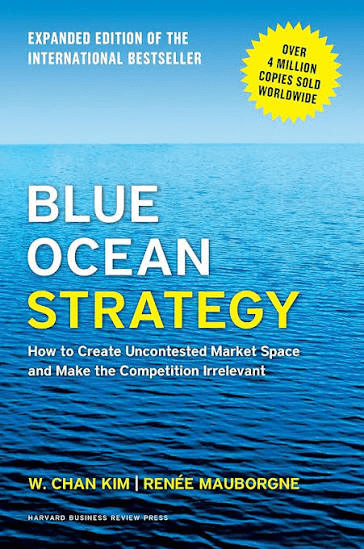
The book behind the idea: Blue Ocean Strategy, by W. Chan Kim and Renée Mauborgne.
The first strategy puts you in a red ocean because, metaphorically speaking, you’re swimming in crowded waters full of hungry sharks. I know, most yoga teachers aren’t shark personalities. But as soon as we enter the marketplace, we become competitors. A blue ocean, on the other hand, is undiscovered open water where you have much less competition.
Both strategies can work:
Red oceans exist because the demand is already proven; people are searching for “Vinyasa class near me” all the time. So if you jump into a red ocean you know that there’s fish you can catch as long as you can somehow outcompete the other shark teachers. Oftentimes this means that you have to offer cheaper prices, be more charismatic, have better content on social media, or just know the right people to get good slots at the right studios.
In blue oceans, it’s the other way around. You don’t need to worry much about competition. But you will probably have to do more work upfront. You have to explain what you offer and why it matters, often to potential customers who don’t even know that they have the problem you want to help them solve.
Why most yoga teachers are standing in the same red ocean
Walk into almost any studio and you’ll find teachers offering versions of the same thing: general Vinyasa Flow (or Vinyasa Flow-like yoga), aimed at the general population, competing for the same students on the same schedules and the same Instagram feeds. Vinyasa isn’t the problem. The problem is that a hundred other teachers within driving distance of you are offering it too.
Meanwhile, styles like restorative, yin, or prenatal yoga are still super small niches in the overall yoga market even though there’s huge potential. Most 200-hour trainings focus almost entirely on Hatha or Vinyasa, which is exactly why so many graduates go looking for a yin training afterward, often years into teaching, once they’ve noticed the gap themselves.
In my opinion, the best example of a blue yoga ocean is seniors yoga. There are literally millions of older adults coming to yoga every year, often on a doctor’s or a friend’s recommendation, but almost no yoga teacher is trained to offer targeted classes specifically for senior students.
Find your blue ocean
If you are teaching already and you just realized that you’re competing in a red ocean, it may be time to look for blue waters. And if you’re not yet teaching, then make sure you set yourself up for success from the start. Because if you find a blue ocean, you can earn more money working fewer hours, the same shift I described at the start, when two private clients paid me more than five or six studio classes ever did. Here are three ideas to consider:
Find a yoga teacher training that teaches multiple styles of yoga. (In the Movement Wisdom 200-hour program, for example, you learn four different styles of yoga because we want to help you become an incredibly versatile yoga teacher.)
Learn to teach yoga for older adults. As mentioned above, seniors are the fastest-growing group of yoga students, and only a few teachers are properly trained. (You can join our Seniors Chair Yoga Training. It’s a 40-hour specialization that helps you become the go-to expert for older adults.)
Find an interesting way to combine yoga with another professional skill. This could be coaching, physical therapy or psychotherapy, singing, dancing… you name it. If you have a particular skill already, you can just give this a shot. If you plan to learn another skill to create a blue ocean, make sure to do some market research first to find out if your idea has legs.
And please note that I’m not suggesting you should drop all your Hatha and Vinyasa classes and never teach those styles again just because there’s a lot of competition. You can keep swimming in crowded waters as long as it’s fun and you give your students good reasons to stick around and come back to your classes.
I hope that this distinction between blue oceans and red oceans is helpful to you.
With love, as always Jess