Takeaways
Using PNF, Isometric Stretching, and creative variations of lunge pose makes your teaching more interesting and keeps your students engaged
Eagle arms and Gomukhasana arms feel dramatically different on each side due to natural shoulder asymmetries—the tighter side is the one that needs the work most
Thigh stretch variations create three distinct experiences: squared-hip version prepares for standing backbends, same-side version adds rotation, and open-hip version creates full front-body opening
Using blocks is usually viewed as "beginner-friendly" - here we can use blocks to create extra challenge in a pose
Beyond Basic Anjaneyasana
When I poll my 200 hour yoga teacher training students, most say that their pre-YTT practice consisted of about 30 poses, done over and over, day in, day out, over a period of months or years. Many of them practiced strict sequences like Bikram or Ashtanga that don't have creative pose variations. Others simply practiced with a teacher who had a chunk of poses that they taught on a loop without changing their class up very much.
Which makes sense...if it's not broken, don't fix it!
Except, one big reason people decide to take a 200 hour YTT, is that they're bored with their regular classes. They they want more. They're tired of doing the standard 30 poses in the exact same way every time they step on their mat. They want to mix things up so they don't lose interest in their practice. They wish their teacher threw in some creative new ways to practice the 'same old poses.'
Because doing your practice the exact same way every time can and will lead to boredom on the mat. And a boring yoga class leads to less and less students coming to class. So why not get creative and bring in some unexpected twists to the standard yoga poses..?
Anjaneyasana (low lunge) is one of those standard poses that makes its way into most sequences, most days. It's foundational, effective, and usually practiced the exact same way every time: legs in lunge position, arms overhead, repeat.
For experienced practitioners and teachers, changing the pose up with just a few small tweaks can keep the pose interesting every single time. This article focuses on upper body variations in low lunge that deepen the experience and add unexpected twists: Eagle arms, Gomukhasana arms, thigh stretches, and using a block in a surprising way.
These anjaneyasana variations maintain the core hip-opening benefits while adding shoulder mobility, chest opening, glute strength and creative sequencing options.
Setting Up Your Foundation in Anjaneyasana
Anjaneyasana: Sanskrit name for low lunge; front foot forward with knee bent, back leg extended with knee down on mat.
Before exploring variations, establish a solid foundation. Step your front foot forward and bend your knee. Extend your back leg and lower the back knee down. Contrary to popular cueing, your front knee can go past your ankle and will generally not cause injury, unless you already have an ACL injury.
Wiggle your back knee back far enough that your bodyweight rests towards the top of your kneecap rather than directly down the middle of it. That usually adds a bit more comfort to the pose, as well as deepening the opening of the back hip flexor. If your back knee is too distracting even after this adjustment, place a blanket under it for cushioning. This simple modification makes longer holds more sustainable.
Eagle Arms: Use Isometric Stretching to Increase Shoulder Opening
Eagle arms (Garudasana arms) in low lunge combines hip opening with deep shoulder and upper back stretching. I consider this a "beginner" teaching variation to Low Lunge. To take your teaching and practice up a notch, add isometric stretching to your Eagle arm variation to deepen the effects in your shoulders and give your students a new experience in this variation.
Start with your arms wide like wings. Exhale and curl inward—either give yourself a hug by crossing your arms and grabbing opposite shoulders, or wrap fully into Eagle arms position.
For full Eagle arms: cross your elbows with one on top. Bend both elbows. Wrap your forearms around each other until your palms meet, or until the backs of your hands touch.
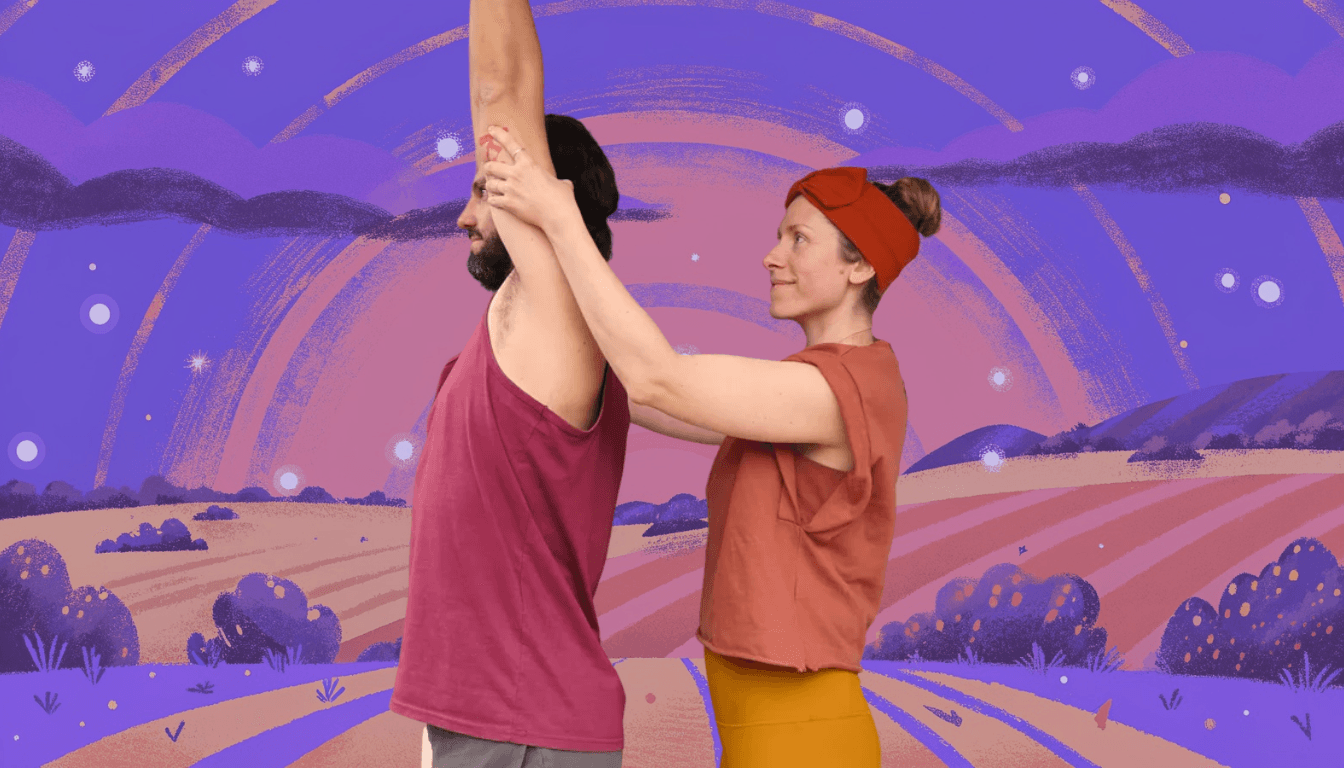
Now, add a little isometric spice to your shoulder stretch: while keeping your arms wrapped in Eagle, imagine pulling your elbows out to the sides. It should feel like you're trying to pull your arms out of the pose, but it doesn't work, as you are maintaining the wrap of your arms. This brings in what's called isometric stretching: we're activating the muscles as we elongate them. Feel the muscles around your shoulderblades and the backs of your shoulders start to fire up as they are simultaneously lengthening. Bring about 20-40% of your maximum effort in here, as the goal isn't to completely fatigue the muscles. The goal is to actually communicate with the nervous system - by contracting the muscles we're stretching, the nervous system allows them to move deeper into the stretch, because it feels like the muscles are safe and being looked after. Hold this isometric stretch for 3-5 breaths. And because this variation can be so fatiguing, I prefer to cue my students into it once in awhile rather than every time I cue Eagle Arms.
Try both sides. One direction will feel significantly different than the other due to shoulder mobility differences.
This variation works in both Anjaneyasana (back knee down) and Crescent Pose (back knee lifted). Same upper body mechanics with different leg engagement.
Eagle arms also transfer to other standing poses. Try them in Warrior II facing the long edge of the mat for extra upper body stretch rather than strengthening focus.
Gomukhasana Arms: Cow Face Shoulder Opener "Pass The Block"
Adding Gomukhasana arms (Cow Face Pose arms) to your low lunge create an intense shoulder opener while maintaining the hip-opening benefits of low lunge. However, there's one playful take on this variation that most students have never tried.
Gomukhasana arms: Cow Face Pose arm position; one arm up and bent with hand between shoulder blades, other arm down and bent reaching up the back, hands clasp....or not :).
Lift your right arm and bend it to take your right hand down between your shoulder blades. Take your left arm straight out to your left, point your thumb down and your palm back behind you, and then bend the elbow and wiggle the back of your hand up your back.
Some students are able to clasp their fingers, but for many others, the hands will feel miles away. Here, using a strap is the standard option, but I prefer a block instead. You can even play a little game (it's deceptively challenging!) where you pass the block from one hand to the other as you switch the arm that's on top, alternating your Gomukhasana arms a few times before transitioning out of the pose.
Squeeze A Block Behind Your Back
One common variation of low lunge is to interlace the hands behind the back. This is a great way to add extra chest-opening in the pose. However, I find that squeezing a block behind the back instead, takes the pose to a whole new level.
To do it, simply grab a block as you come into your low lunge. Hold the block in one hand and bring both hands behind you around your low back. Take the block lengthwise between your two palms, and squeeze both hands into the block with about 20% effort. You'll probably notice that all of a sudden, your hip flexors take a back seat and your arms, shoulders and chest become the main focus of the pose!
In this creative variation, not only are you opening your hips, but you strengthen the following muscles:
Rhomboids (major and minor) -These squeeze your shoulder blades together (scapular retraction). With the block behind your back, your scapulae are already retracted, and pressing inward intensifies this.
Middle and lower trapezius -These assist with scapular retraction and stabilization.
Posterior deltoids - Helping hold your arms in the behind-the-back position (shoulder extension).
Pectoralis major - Here's the interesting one. Even though your arms are behind you, the act of pressing your hands toward each other recruits your pecs, even if no movement is occuring anywhere around your chest. Try it and you'll see what I mean after just a few seconds!
Triceps - If you think Chaturanga is the only tricep-strengthener we have in yoga, think again! With this variation, keeping the elbows straight under load fires up the triceps in a big way. So this is a great pose to help you gain more control in your Chaturanga.
For practitioners working toward deeper backbends later in practice (Wheel, Camel, Dancer Pose, etc.), this variation serves as effective preparation, as it contracts and engages many of the same muscles that we need to be fully functional and online for bigger backbending poses.
Thigh Stretch Variation: Add PNF Quad Activation
PNF most commonly stands for Proprioceptive Neuromuscular Facilitation, which is a therapeutic technique that involves contracting muscles as you stretch them, followed by releasing the contraction and "sinking in" to the pose in a more passive stretch. All of this without ever changing the shape of the pose or making any noticeable adjustments to the pose from an outsiders perspective.
Similar to the Isometric Stretching technique we looked at earlier in Eagle Arms, PNF involves contracting the same muscles that we're stretching. The only difference, is that now, after we contract the muscles for a few breaths, we release the contraction and allow the muscles to relax into the position. This method helps improve flexibility, range of motion, and strength. It is often used in physical therapy and sports training and is still relatively new and unheard of in yoga classes.
Starting position: Low lunge
Begin in a low lunge with your right foot forward, right knee bent.
Take your left knee down on the mat, with the top of your left foot on the floor (rather than toes tucked under).
Keep your torso upright and take your hands on your hips or your front thigh.
Adding the PNF contract-relax sequence:
Step 1: Find your stretch Sink your hips forward and down until you feel a stretch in the front of your left hip (hip flexors) and possibly the front of your left thigh (quadriceps/rectus femoris). This is your starting point, and usually where the pose ends. Let's mix it up instead!
Step 2: Isometric contraction (the "contract" phase) Press the top of your left foot and shin down into the mat as if you're trying to straighten your back leg or drag your knee forward. Your leg won't actually move — it's an isometric contraction.
This fires up your hip flexors and quads on the back leg — the very muscles you're stretching.
Hold this contraction for about 5–10 seconds at roughly 20–50% effort (not maximal). Keep breathing.
Step 3: Relax and deepen (the "relax" phase) Release the contraction completely, exhale, and let your hips sink deeper into the lunge. You should find you can access a greater range of motion now.
Step 4: Repeat Cycle through 2–4 rounds of contract-relax, gaining a bit more depth each time.
Then switch sides.
Why it works: The isometric contraction triggers autogenic inhibition — after the muscle contracts, the Golgi tendon organs signal it to relax, allowing you to stretch further than passive stretching alone. This is a fancy way of saying that our nervous system will allow muscles to stretch more after they contract. It's a safety mechanism of the nervous system that we can use to our benefit when our goal is to stretch deeply.
Strengthen Glutes and Hamstrings With A Creative Block Variation
In this variation, we strengthen the glutes and hamstrings by bending the back knee. Then we use a block for even more creativity and pizzaz!
To set up the pose, come into Low Lunge with your right foot forward and your legs wide enough that you can sink your hips down into the pose somewhat. Keep both hands on the floor or on blocks for now.
Take a block into your right hand, bend your left knee, and reach the block back to touch the back of your left heel. Flex the left foot. Now, instead of just holding the block and heel together, actively press the block into your left heel with your right arm, and simultaneously, kick your left heel into the block as if you want to move it towards your spine.
Notice your glutes and hamstrings activating - this only happens in the front leg in the standard version of the pose. Enjoy the sensations for a few breaths, then release.
This is not only a great prep pose for strong backbends, but because we're contracting the muscles on the backs of the legs, it's a great prep for deeper stretching in forward folds like Paschimottanasana. The glute and hamstring contraction signals to the nervous system that those muscles are safe to stretch.
Side Bend Variation: Lateral Isometric Stretching
Come into Low Lunge with your right leg forward.
Start with both hands on your hips. Lift and lengthen your chest. Roll your shoulders back. Find side body length.
Core activation is essential in this variation, so lift your low belly up, slide your tailbone down toward the mat, and use your low belly muscles to pull your frontal hip points towards each other, even just one milimeter. This will give some support to your lumbar spine during the side bend.
Inhale and reach your left arm up to the sky. Exhale and side bend over to your right. Bend your left elbow and cradle your head in your hand. Gently press your head back into your hand and notice if that creates even more lengthening from the left hip flexors, up the left side of the body, and up into the left shoulder and arm. Focus on lifting your left elbow toward the sky as you lean your head back.
Take your right hand to your left elbow. We could stay here and use the right arm to create more of a passive opening through the left side of the body. However, if we add a pinch of muscular activation through isometric stretching, we can deepen the side-body opening we're after.
With about 10% of your maximum effort, push your left elbow into your right hand, but use your right hand to resist this movement to the left. This means that your body won't move in space, but you'll feel activation up and down the entire left side of your body.
This fires up the lateral stabilizers — obliques, serratus, shoulder — while you're simultaneously lengthening them. Hold for 3–5 breaths. Release slowly. Lift your chest up in slow motion to come back to an upright position.
Integrating isometric stretching in this lateral Low Lunge creates that same nervous system "safety signal" we've looked at before that lets the muscles release more deeply afterward. This technique creates big opening along the lateral myofascial line—the continuous connective tissue structure running from your outer hip, along your ribs and intercostal muscles, all the way to your armpit and up your arm. This fascial connection, described in Thomas Myers' Anatomy Trains system, often gets compressed and shortened from daily postures like sitting, driving, and carrying bags on one shoulder. The side bend in low lunge targets this entire lateral chain in one integrated stretch.
This variation splits the focus of the pose between hip flexor stretch and lateral body opening while maintaining the lunge foundation and is great as prep for Wheel Pose, Dancer, and other backbends.
All Variations Lead To Rome
All of these Anjaneyasana variations work wonders for many parts of the body, mind and nervous system.
However, they do one thing exceptionally well: preparing the body for deeper backbends.
With all the stretching and strengthening through Isometric Stretching and PNF, the shoulders - via a nervous system that feels safe and supported - tend to feel more prepared for challenging backbends that require both openness and strength in the shoulders, like Wheel Pose.
Passing the block in Gomukhasana arms not only adds an unexpected proprioceptive element to the pose, but also moves shoulder joints through increasing ranges of motion with every pass of the block from one hand to the other.
And pushing a block into your back heel fires up the entire back line of the body, which will also need to activate strongly in poses like Bow, Wheel, and Dancer. As a bonus, a strong and fired up back line of the body actually allows for more stretching and flexibility in the front side of the body.
All of these poses can be used as intelligent, playful, creative ways to teach Low Lunge, or to warm up for bigger backbends that require more strength and openness.