The Unexpected Obstacle in Arm Balances
Most practitioners assume arm balance struggles stem from lack of strength. Weak shoulders, insufficient core engagement, underdeveloped wrist stability - these are the usual suspects my students cite. But is that the real reason they can't pop up into Crow Pose...?
I can't tell you how many times I've had students come up to me after class and say they will one day be able to do Crow, or 8-Angle Pose, or whatever arm balance I taught in class...just as soon as they improve their core and arm strength. But when I observe those same students during practice, they're able to hold Downdog for extended periods. They hold Plank. They can do Chaturanga with skill. Or they have a killer Boat Pose - usually way stronger and more easeful than mine! So it can't be explained away by weak arms and core, can it...?
If you can hold Downward Facing Dog for 10 breaths, I'm willing to bet that you have sufficient shoulder strength for arm balances. If you can do boat pose for just 5 breaths, I'd bet that's enough for any arm balance. So...why do your feet barely leave the floor whenever you try..? I have an idea.
In both my personal and professional experience, the issue isn't as much in your muscles as it is in your brain. Your brain and nervous system, actually. To conquer this dilemma and be able to lift off in arm balances, regularly getting on your mat to practice asana (yoga poses) helps for one very surprising reason.
Doing Asana Trains Your Nervous System
The real magic of consistent asana practice isn't just building a stronger core or getting more flexible hamstrings, though those benefits certainly come along for the ride and will help you with your arm balances. But what's actually happening on your mat is something far more invisible.
When you give yourself smaller challenges on the mat as you work your way towards Crow Pose or Handstand, you train your nervous system to recalibrate its threat assessment. Each time you approach an arm balance or inversion, even if you don't "nail" the pose - or even if you just do the preliminary steps and don't even attempt to float off the floor - you're providing your brain with crucial data that updates its internal safety model.
Research on anxiety and motor performance shows that our nervous system creates predictions about what we can and cannot do, and bases our performance on that hypothesis. If we take Crow Pose as an example, when we believe we can't do the pose, our fight-or-flight response ramps up, and the fear of even trying changes how we perceive the challenge. Studies on rock climbers found that anxious climbers perceived a route as more difficult and experienced measurably higher muscle fatigue than their fearless counterparts, not because they lacked strength, but because their nervous system was operating in a fear state.
If you've ever had a phobia of flying, spiders, or heights, you might have tried "exposure-based therapy," where you take baby steps to become more and more comfortable in doing the thing that scares you. If, for example, you're deathly afraid of spiders, your therapist might set up real-world scenarios that train your brain and nervous system to overcome your fear. On day one, you might enter a house that has a spider in the attic. The next week, you might sit in the room next to a room with a spider in it. The next week you might step one foot into the room with the spider, etc. And eventually one day you would probably be able to even hold a spider in your hand. It's a step-by-step training program for your nervous system.
Well, this is what we do on the yoga mat as well. Every time we come into Dolphin Pose and lift one foot off the floor, it programs our nervous system to be a little bit more ok with eventually coming into a Forearm Stand (Pincha Mayurasana). Every Chaturanga or Plank you hold for a couple of breaths teaches you to be familiar with similar feelings you will experience in your hands in Crow Pose or any other arm balance.
Through repeated exposure to manageable challenges, the neural circuits connecting your amygdala, prefrontal cortex, and cerebellum undergo actual plastic changes, gradually learning that these unfamiliar positions are safe. This is why time on the mat matters so much when you're attempting challenging poses. It's not just about getting stronger or more flexible physically, it's about actually reprogramming deeply ingrained survival responses.
What This Looks Like in Practice
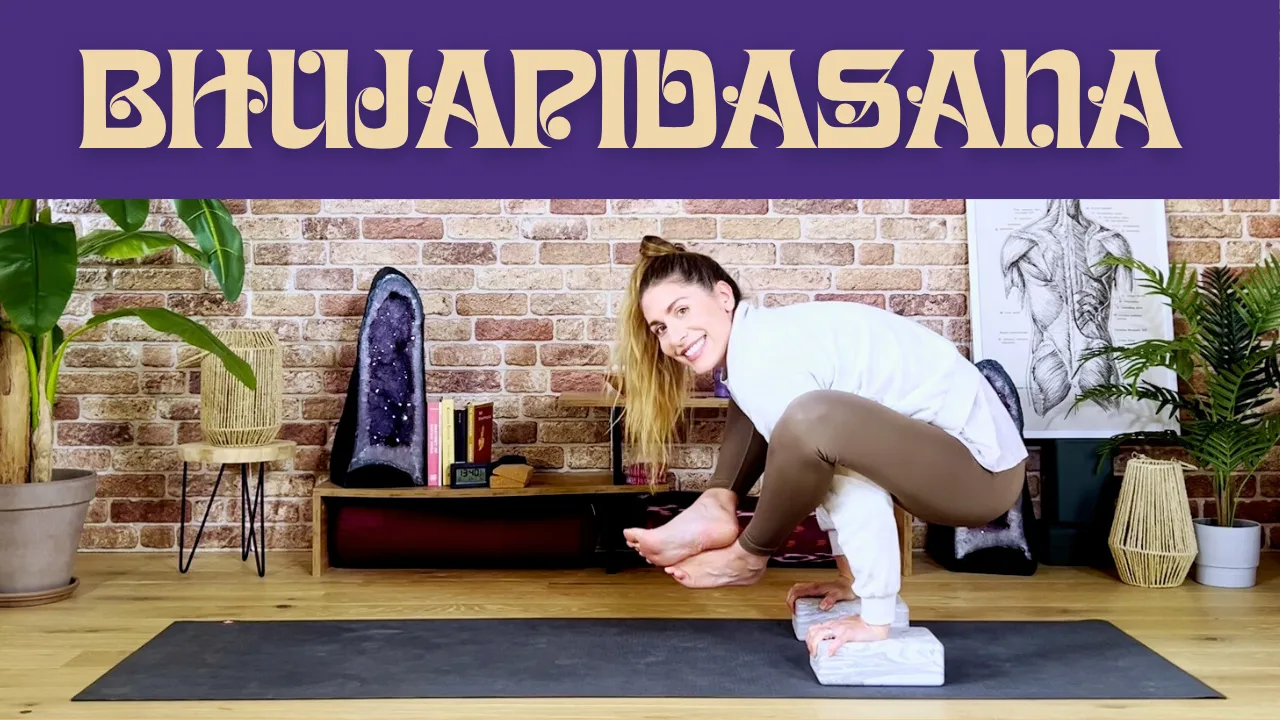
I frequently see this pattern in my classes. Take Shoulder-Pressing Pose (Bhujapidasana) as an example. Students set up perfectly for Bhujapidasana with shoulders wedged high into the knee creases, hands planted firmly behind the heels, and knees deeply bent. They have all the physical components in place. But when the moment comes to shift their weight backward and sit onto their arm shelf, they freeze. They can't take the final backwards shift to float their feet off the mat.
Some students even have the strength to hold this uncomfortable hovering position for several breaths, which actually requires more muscular effort than the pose itself. But they cannot make themselves sit back those final few centimeters.
I use this pose as an example because most people don't doubt their arm strength here. Instead, they doubt the unknown. It's like sitting down on porta-potty at a music festival - your rational brain knows the seat is there, but every survival instinct screams "don't sit on what you can't see! You have no idea what's back there!" When I ask students what stopped them from lowering back, the answer is almost never "my arms weren't strong enough." Instead, they say they felt uncertain whether their arms would catch them, feared tipping backward, or simply couldn't override that primal "abort mission" signal. The strength is there, it's the nervous system that just hasn't given permission yet.
The 'Finger Brakes' Technique: Building Trust Through Small Steps
I teach a technique I call 'Finger Brakes' specifically designed to address fear in forward-leaning arm balances. Students practice leaning forward until they press into their fingernails. You'll know you're there when the nail beds turn white or lighter from the pressure. Shift your weight back and forth into and out of your fingernail "brakes" until you start to feel comfortable that your fingertips will be your brakes if you fly forward out of control. This builds trust that hands can act as brakes.
This technique is one of the most important aspects of getting into arm balances because it trains the nervous system to trust the hands and wrists to support forward weight shifts without fear of face-planting. The practice develops confidence incrementally rather than demanding full commitment immediately. By experiencing controlled weight shifts repeatedly, practitioners prove to themselves that their foundation is reliable, which dissolves the psychological barrier.
Do this first in Tabletop, so you have a bit less weight in the hands. Once that feels safe, do it in Plank Pose and see how your fear response changes. Once you feel comfortable doing it in Plank, it's time to try it in Crow!
Modifications That Address Fear, Not Just Strength
We often think of using blocks and other props to help make the pose physically easier. But actually, props can help our nervous system feel safer with challenge, as well. In Shoulder-Pressing Pose, using blocks stacked at lowest height behind the heels provides a higher platform for hands, which can help shorter-armed practitioners reach the ground more easily. However, blocks serve two distinct purposes: accommodating arm length (physical) and providing psychological security for those afraid of sitting back into unknown territory (mental).
The setup involves placing blocks shoulder-distance apart behind heels, with feet positioned a few inches forward of blocks (about one-third of foot length). This modification allows practitioners to feel the blocks as a tangible landing spot, reducing the 'unknown territory' factor that triggers hesitation. The key is recognizing whether you need the modification for physical accommodation or psychological support. Both are valid, but understanding which applies helps you progress appropriately.
Reframing the Practice: Exploration Over Mastery
Give yourself credit for the attempt regardless of outcome. Even if you fall and your butt smacks down on the floor, it doesn't matter because this represents the fun, exploratory part of yoga! Arm balances often present sudden breakthrough experiences, whether we nail them, or just try something we never thought we would. For most people who aren't former gymnasts or acrobats, having your feet simply float up unexpectedly one day is a magical, empowering experience. And that's why I love arm balances so much, and why I love teaching them. It's not about showing off. It's about proving to yourself that you are far more powerful than you think, and that no possibility is off the table.
This breakthrough happens when the mental barrier dissolves, and usually not when strength increases. Students might think they've been preparing by working on their core or their hamstrings, but I firmly believe that's a code word for reprogramming their nervous system to just be OK to try. And I also love to remind my students that the path is not even necessarily the goal. It's not the pose itself that is the point - it's the process and what we learn (and teach ourselves) along the way. The practice phase isn't failure, because it's building the neural pathways and trust that will eventually allow the breakthrough.
Identifying Your Real Limitation
When we're scared of arm balances, it's easy to default to "I need more strength," or "I need more flexibility." And of course, it's possible that you do. But it's very possible that you don't. See if you can identify specifically where you feel limited. Is it wrist pain? Shoulder discomfort? Lack of core strength? Or fear of falling..? Remember that the obstacles to achieving challenging poses aren't always physical. The limitation could be mental, emotional, or simply the neurological unfamiliarity of something completely new to your body.
Once you identify the specific limitation, you can apply targeted solutions rather than generic encouragement to 'practice more.' Ask yourself: "Am I actually too weak, or am I simply unwilling to risk the embarrassment of falling down?"
The answer to that question usually determines whether you need to build strength or build trust. Trust often develops faster than muscle.