Yoga Anatomy

Why Your Arm Anatomy Determines Optimal Hand Placement in Every Yoga Pose

The universal cue to place your hands shoulder-width apart ignores a fixed skeletal feature that affects how your arms naturally align, and explains why some practitioners struggle with arm balances no matter how much they practice.

Created by:Jess RoseJess RoseRead time:11 min

Takeaways

  • The carrying angle is the natural angle between your upper and lower arm bones. It varies from 5-20 degrees between individuals and determines optimal hand placement in weight-bearing poses

  • Forcing standard 'hands under shoulders' alignment when you have a pronounced carrying angle creates shoulder instability and wrist strain, not because you lack strength but because you're fighting your bone structure

  • Wider hand placement and adjusted finger direction accommodate carrying angles, often making the difference between struggling in arm balances and finally progressing in them

  • The carrying angle is a fixed skeletal feature you're born with—it cannot be changed through stretching or strengthening, only accommodated through modified hand placement

The Hidden Anatomical Factor Affecting Your Arm Balances

In nearly every yoga class, you'll hear the same alignment cue: 'Place your hands shoulder-width apart, directly under your shoulders.' Teachers repeat this instruction in Crow Pose, Plank, Downward-Facing Dog, and countless other poses. It sounds simple and universal.

But here's what most teachers don't tell you, and what many teachers don't know: this one-size-fits-all instruction ignores individual anatomical differences. Specifically, it ignores what's called the carrying angle—the natural angle formed where your upper and lower arm bones meet at the elbow.

Many of my yoga students and yoga teachers-in-training report chronic wrist discomfort in weight-bearing poses, especially in arm balances and inversions. Many of these practitioners struggle not because they lack strength or dedication, but because standard hand placement creates misalignment in their unique skeletal structure.

The carrying angle varies significantly between individuals. Research shows it ranges from 5-20 degrees in the general population, with women averaging 13-16 degrees and men averaging 10-15 degrees. This variation—which you're born with and cannot change—determines your optimal hand placement across all yoga poses involving weight on the hands.

Understanding your carrying angle allows you to modify hand placement for better stability, healthier shoulders, elbows and wrists, and actual progress in challenging poses - all due to hand placement that fits your unique carrying angle.

For more than a decade, I practiced yoga with no knowledge of carrying angles, including my own. After years and years of Chaturangas, my elbows started to hurt with no explanation. I would feel a weird pop every time I lowered down from Plank, and it felt like connective tissue was snapping over the bones at my elbow joint.

I asked all of my yoga teachers for help, and no one knew how to help. The general advice was, "Make sure your hands are directly under your shoulders for optimal alignment, and hopefully that helps."

It turns out, that this "optimal alignment" was actually causing my problem. It was only years later that I learned about carrying angles, and figured out that mine was pretty big. My unique arm angles meant that when I followed the standard cue of "hands under shoulders," it created a drastic internal rotation at my shoulders, caused my elbows to splay out, and also meant that keeping my index fingers on the mat in Hasta Bandha was nearly impossible.

Once I realized that I have an XL carrying angle, I changed my hand placement by taking my hands wider than my shoulders and spiraling my fingers outward slightly, and my elbows have been problem-free ever since.

What Is the Carrying Angle?

The carrying angle is the natural angle formed between the humerus (your upper arm bone) and the radius and ulna (your lower arm bones) when you have your arms hanging at your sides with palms facing forward in anatomical position. These upper and lower arm bones meet at the elbow joint, and for most people, they don't form a perfectly straight line. Instead, they create a slight outward angle, meaning your hands splay outwards from your hips to help you avoid bumping your hands into your legs when you walk.

Carrying angle: The lateral angle between upper and lower arm bones at the elbow joint; visible when arms hang naturally at the sides or extend outward; a fixed skeletal feature that varies between individuals.

This angle typically ranges from 5-20 degrees, with significant individual variation. Women average 13-16 degrees while men average 10-15 degrees. Angles above 15 degrees are considered pronounced and typically require hand placement modifications in weight-bearing yoga poses. This anatomical variation affects how your arms naturally hang at your sides.

Carrying angles are quite common, especially among female practitioners, though they occur across all body types. This angle is a fixed skeletal feature. You're born with it and it cannot be changed through stretching, strengthening, or alignment work.

How to Assess Your Carrying Angle

You can identify your carrying angle with one simple test.

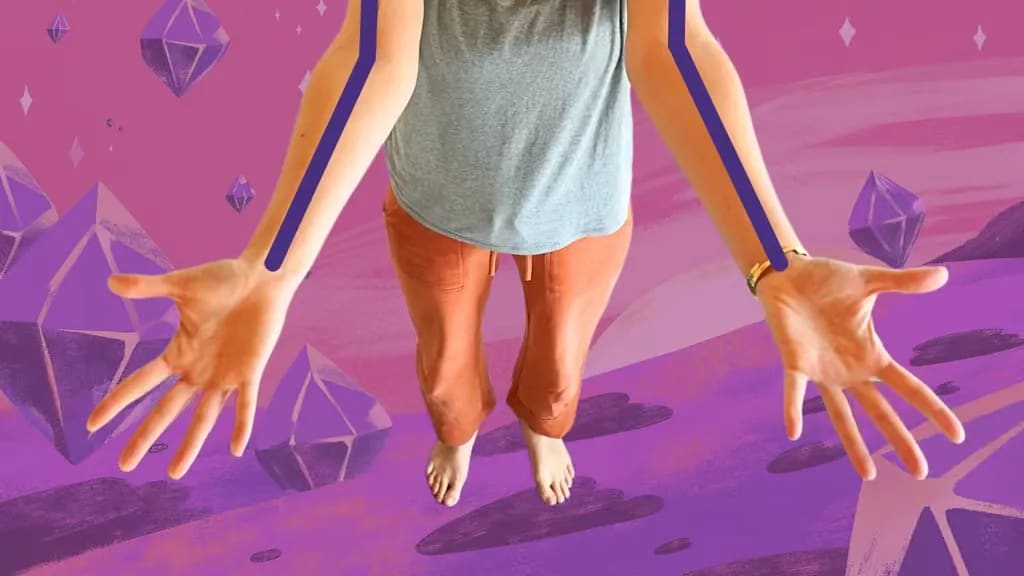
Stand in front of a full-length mirror in Mountain Pose with your arms straight down at your sides, palms facing forward. Keep your hands in a straight, continuous line from your lower arms. If your hands naturally angle away from your thighs rather than hanging straight down alongside them, you have a carrying angle. In other words, your upper arm bones will be relatively perpendicular to the floor beneath you. If you have no carrying angle, your lower arms will also be perpendicular to the floor. But if you have a carrying angle, your lower arms will angle out away from your legs so that your lower arms splay outwards rather than straight down.

The more pronounced your carrying angle, the more your hands will angle away from your body's centerline when your arms are extended.

How Carrying Angle Affects Yoga Alignment

When someone with a carrying angle places their hands directly underneath their shoulders in weight-bearing poses, their arm bones aren't in optimal alignment. The angle at the elbow creates a structural mismatch. It's like trying to set up a ladder against a wall when the ladder's legs are angled outward. You can force it straight, but it's unstable and fighting its natural structure. Just as the angled ladder legs need wider placement at the base to be stable, your arm bones need wider hand placement to stack efficiently when you have a carrying angle.

This misalignment makes it nearly impossible to properly engage hasta bandha and keep the index finger knuckles grounded, regardless of how much effort you apply to hand engagement.

Hasta bandha: Sanskrit term meaning 'hand lock'; the active engagement of hands in weight-bearing poses, including grounding through knuckles and creating a slight dome in the palm; requires optimal skeletal alignment to execute properly.

Forcing standard 'hands under shoulders' alignment for practitioners with carrying angles creates internal rotation at the shoulder joint. This leads to instability and potential strain. The arm bones essentially fight against their natural angle, creating unnecessary tension and reducing the ability to bear weight efficiently through the hands.

Internal rotation: Movement of the upper arm bone rotating inward toward the body's centerline; when forced in weight-bearing poses, creates instability and potential shoulder strain.

The Problem with Standard Alignment Cues

Teachers often insist on 'hands directly under shoulders' and 'middle fingers pointing forward' as universal alignment principles. For practitioners with carrying angles, these cues force the body into misalignment rather than supporting optimal skeletal stacking.

This approach prioritizes standardized positioning and universal alignment cues over anatomical individuality—the opposite of what safe, effective yoga practice requires. Students may blame themselves for 'doing it wrong' or lacking strength when the real issue is attempting to force their unique structure into an alignment that doesn't serve their anatomy.

Adjusting Hand Placement for Your Carrying Angle

Wider Hand Placement

Practitioners with larger carrying angles find much better success by placing their hands wider than shoulder-width apart in all weight-bearing poses. This wider placement allows the arm bones to align properly according to their natural angle, making it much easier to maintain proper weight distribution through the hands.

The wider stance accommodates the outward angle of the lower arm bones, creating a stable base that works with rather than against skeletal structure. This modification addresses the anatomical challenge rather than forcing incorrect alignment.

Finger Direction Adjustments

Instead of pointing middle fingers straight forward, practitioners with carrying angles should point index fingers forward or slightly splay fingers outward. Turning fingers slightly outward creates a more neutral position for the wrist joints when the carrying angle is present.

If you have a carrying angle, avoid pointing your middle fingers forward, which increases internal rotation at the shoulder and compounds the misalignment. The finger adjustment works in conjunction with wider hand placement to create optimal alignment from fingertips through shoulders.

Applying Carrying Angle Awareness to Specific Poses

Crow Pose (Bakasana)

Crow Pose makes carrying angle misalignment particularly obvious because the pose requires precise balance and weight distribution. If you find yourself struggling with balance, unable to lift one foot, or constantly falling forward when your hands are placed directly under your shoulders, try widening your hand placement first.

Many practitioners discover that adjusting hand width and finger direction dramatically improves their stability and ability to progress in the pose—often the difference between getting into the pose or not. The wider base accommodates the carrying angle and allows proper engagement of the arms and shoulder joints to support body weight.

Downward-Facing Dog (Adho Mukha Svanasana)

In Down Dog, practitioners with carrying angles often experience wrist discomfort or inability to ground through index finger knuckles when hands are shoulder-width apart. Widening hand placement and turning fingers slightly outward can create significant relief and allow proper weight distribution through the entire hand.

This adjustment also reduces strain on the shoulder joints by allowing them to sit in a more neutral position rather than forced internal rotation. The principle applies whether holding the pose statically or moving through Sun Salutations.

Plank Pose and Four-Limbed Staff Pose (Chaturanga Dandasana)

Standard alignment in Plank calls for hands directly under shoulders, but this leads to instability for those with carrying angles. Wider hand placement in Plank provides a more stable foundation and allows proper shoulder engagement without the internal rotation that leads to shoulder strain.

In Chaturanga, the carrying angle affects not only hand placement but also elbow tracking. Wider hands allow elbows to track back more naturally alongside the ribs. These modifications support shoulder and elbow health and sustainability in vinyasa-style practices that repeat these poses frequently.

Side Plank (Vasisthasana)

Side Plank concentrates all upper body weight onto one arm, making proper alignment even more critical for practitioners with carrying angles. The bottom hand may need to be placed slightly forward of the shoulder rather than directly under it to accommodate the carrying angle.

Finger direction becomes especially important. Turning fingers to angle slightly back towards the top corner of the mat rather than pointing them straight ahead can create better wrist and shoulder alignment.

Wheel Pose (Urdhva Dhanurasana)

Interestingly, despite having a natural carrying angle that angles the arms outward, practitioners often have the tendency to bring hands closer together rather than wider apart in Wheel Pose. This counterintuitive pattern can create consequences for the shoulders and elbows when not addressed properly.

Practitioners with carrying angles should consciously place hands wider than feels instinctive in Wheel, allowing the arm bones to stack according to their natural angle. This wider placement supports safer shoulder positioning and more sustainable backbending.

Teaching Implications: Offer Variations Instead of Universal Cues

As teachers, it's important to offer hand placement variations rather than insisting on the standard 'hands under shoulders' cue as the only correct option. Since carrying angles are quite common, providing options for wider hand placement and finger positioning helps many students find their most stable and sustainable alignment.

However, in reality, it's challenging to cue hand placement when moving students through rounds of Sun Salutes - there's no time to call out all the options for hand placement when it's one movement per breath.

For that reason, I often teach my students how to find their carrying angle (if they have one) in Mountain Pose at the beginning of class. Then I let them know that every time I give the cue to place hands under shoulders, it means that they should take the variation of that suited to their unique carrying angle.

It's easier than saying "Find the unique hand placement that allows your arm bones to stack efficiently based on your own unique carrying angle. :)"

Encourage students to experiment with hand width and finger direction, noticing where they feel most stable and where weight distributes most evenly through the hands. This approach prioritizes anatomical individuality over standardized positioning—the foundation of safe, effective yoga practice that serves diverse bodies.

Distinguishing Carrying Angle from Elbow Hypermobility

Carrying angle and elbow hypermobility are two completely different anatomical features that are often confused in yoga practice.

Elbow hypermobility refers to excessive extension at the elbow joint—the ability to hyperextend the arm beyond straight. Carrying angle refers to the lateral angle between upper and lower arm bones, visible when the arm is straight, not hyperextended.

Understanding this distinction is important for proper arm alignment during asanas because these features affect different aspects of arm positioning and require different considerations. A practitioner can have a carrying angle without hypermobility, hypermobility without a carrying angle, both, or neither. They're independent anatomical variations.

Working With Your Anatomy

Yoga alignment must serve individual anatomy, not force bodies into standardized positions and universal alignment. The carrying angle is just one example of how skeletal variation affects optimal positioning in practice.

Once you understand your carrying angle, you can make informed choices about hand placement across all weight-bearing poses. You'll likely notice immediate improvements in stability, reduced wrist discomfort, and better access to challenging arm balances. Not only that, you'll practice will become more sustainable and reduce your chances of injury in the long-term.

FAQ

FAQ

How do I know if I have a carrying angle or if my alignment is just off?

The simple standing test gives you a clear answer: stand with your arms at your sides, palms facing forward. If your hands fall away from your thighs rather than hanging straight down, you have a carrying angle. This is a fixed skeletal feature visible in your natural arm position, not something that changes based on how you're standing or your muscle engagement. If you consistently struggle with hand placement in weight-bearing poses despite proper instruction and adequate strength, the carrying angle is likely a factor. Consider taking a photo of yourself standing with arms extended to the sides, palms forward—the angle will be clearly visible.

Will wider hand placement make me weaker in arm balances?

No. Wider hand placement that matches your carrying angle actually creates a more stable base and allows better force distribution through properly aligned bones. Working against your anatomy by forcing narrow hand placement creates instability and prevents optimal engagement, regardless of your strength level. Many practitioners find they can finally progress in arm balances once they widen their hands to accommodate their carrying angle. Strength is most effective when skeletal structure is optimally aligned—wider placement supports rather than undermines strength development.

Should I always place my hands wider in every yoga pose?

The carrying angle primarily affects weight-bearing poses where hands are on the ground supporting body weight: arm balances, Plank, Down Dog, Chaturanga, and similar poses. In poses where arms are extended but not weight-bearing—Warrior II, Triangle, and others—the carrying angle is less relevant to alignment. The key is understanding your anatomy and applying wider hand placement specifically where it creates better skeletal alignment and stability. Experiment in different poses to notice where the adjustment makes a meaningful difference versus where standard placement works fine.

Can I change my carrying angle through stretching or strengthening?

No. The carrying angle is determined by the shape and angle of your bones where they meet at the elbow joint, which is a fixed skeletal feature you're born with. No amount of flexibility work, strength training, or alignment practice can change the angle of your bones. This is why understanding and accommodating your carrying angle is essential rather than trying to force your body into standard alignment. The goal is to work with your unique anatomy, not attempt to change it.

As a yoga teacher, how do I cue hand placement for students with different carrying angles?

Offer hand placement as a range rather than a single position: 'Place hands shoulder-width apart or wider, finding where your arms feel most stable.' Encourage students to experiment with finger direction: 'Notice whether pointing index fingers forward or slightly splaying them outward creates better weight distribution.' Avoid insisting that middle fingers must point forward or hands must be exactly under shoulders—these universal cues don't serve all anatomies. Teach students the carrying angle assessment so they can understand their own anatomy and make informed choices about hand placement.

Does carrying angle affect other joints besides the arms?

The term 'carrying angle' specifically refers to the angle at the elbow joint between upper and lower arm bones. Similar anatomical variations exist at other joints—hip socket depth, femoral angle, and others—that also affect yoga alignment, but these are distinct features with different names. Understanding that anatomical variation affects alignment throughout the body helps practitioners and teachers move away from one-size-fits-all cueing. The principle of accommodating individual skeletal structure applies across all joints, not just the elbows.

More lessons

Jess in Standing Forward Fold on a soft orchid-to-lilac background, folded deeply over her legs with her hands flat on the floor and her head hanging down – Movement Wisdom lesson on how to do Standing Forward Fold
Yoga Poses

Pose breakdown: Standing Forward Fold

Article
A woman in Child’s Pose on a soft violet background, kneeling with the hips back toward the heels, forehead on the floor and arms reaching forward – Movement Wisdom lesson on how to do Child’s Pose
Yoga Poses

Pose breakdown: Child’s Pose

Article
The Movement Wisdom yoga teacher earnings calculator, tilted on a plum gradient: $40 per class and 5 classes a week come to $866 a month – Movement Wisdom lesson on yoga teacher earnings
Yoga Business

Yoga Teacher Earnings Calculator

2 min read
Wheel Pose with straight arms and bent knees, hands and feet on the floor and the front of the body lifted in an arch – Movement Wisdom lesson on how to do Wheel Pose
Yoga Poses

Pose breakdown: Wheel Pose

Article
Half Pigeon Pose folded forward onto the forearms, front knee behind the front wrist and back leg extended – Movement Wisdom lesson on how to do Half Pigeon Pose
Yoga Poses

Pose breakdown: Half Pigeon Pose

17 min read
Jess Rose in Downward-Facing Dog on a yoga mat, hands and feet down and hips lifted into an inverted V – Movement Wisdom lesson on how to do Downward-Facing Dog
Yoga Poses

Pose breakdown: Downward-Facing Dog

14 min read
Floating flashcards with Devanagari letters circle a lone tree on a purple hill at dusk – Movement Wisdom
Yoga Poses

Flip & Learn: Sanskrit Pose Names

5 min read
Open flashcard showing the Sanskrit word dharma beneath a golden sun and rippling rings – Movement Wisdom
Yoga Philosophy

Flip & Learn: Yoga Philosophy Words

5 min read
Flashcard reading the Sanskrit word prana in front of rainbow arcs over rolling purple hills – Movement Wisdom
Breathwork

Flip & Learn: Pranayama Names

5 min read
Glowing card with the Sanskrit word chakra against radiating sunburst rays at dusk – Movement Wisdom
Yoga Philosophy

Flip & Learn: Chakras & Nadis

5 min read
Yoga teacher cupping a student’s upper arms as he reaches overhead, in front of an illustrated violet landscape with rolling fields
Teaching Skills

How to Give Yoga Assists (and When Not To)

8 min read
Split illustration of a calm blue ocean beside a crowded red ocean with a fishing boat and shark chasing fish
Yoga Business

Business Strategy for Yoga Teachers: Red Ocean vs. Blue Ocean

4 min read
Illustrated city map seen from above, its streets and blocks standing for the many places yoga teachers get hired - Movement Wisdom
Yoga Teacher Training

37 Places Where Yoga Teachers Get Hired

7 min read
Illustrated figure sweeping a floor covered in large empty speech bubbles, clearing a glowing path behind them
Yoga Anatomy

10 Outdated Yoga Cues You Can Safely Ignore

28 min read
Illustrated person standing over a long table covered with dozens of yoga teacher training brochures, weighing which one to choose
Yoga Teacher Training

The 10 Hallmarks of an Excellent Yoga Teacher Training

12 min read
Grid of six illustrated objects representing the six yoga archetypes: stethoscope, kettlebell, tape measure, open book, flowing ribbon, and crystal – Movement Wisdom yoga archetype quiz
Yoga Styles

The 6 Yoga Archetypes: Which One Are You?

6 min read
Illustrated grid of glowing star-marked tiles laid across violet hills under a dusk sky – Movement Wisdom Yoga Wordle
Knowledge

Yoga Wordle

2 min read
A tattooed student lifting into Cobra Pose while Jess Rose guides her shoulder – title card for the Cobra Pose Asana Lab
Yoga Poses

Asana Lab: Cobra Pose

22 min watch
Jess Rose in a wide side-bending lunge with one arm reaching overhead – title card for the Dancing Warrior Asana Lab flow class
Free with email
Yoga Poses

Asana Lab: Dancing Warrior Flow

15 min watch
Jess Rose smiling with her palms together in a sage-green studio, a man seated in front of her – title card for the Stress Buster restorative yoga class
Free with email
Yoga Class

Stress-Busting Restorative Yoga

56 min practice
Jess Rose kneeling on a mat, drawing her back foot in toward her body — title card for the Full Body Flexibility yoga class
Yoga Class

Full Body Flexibility

37 min practice
Title card for the Nadis and Chakras 101 lesson
Free with email
Knowledge

Nadis & Chakras: A Beginner's Guide to Your Subtle Body

12 min read
A man holding a low plank over a bolster while Jess Rose coaches him from beside – title card for the Chaturanga Dandasana Asana Lab
Free with email
Yoga Poses

Asana Lab: Chaturanga

27 min watch
A smiling pregnant yoga teacher in a seated side bend, one arm overhead and a hand on her belly – title card for Prenatal Yoga Challenge, Day 3
Free with email
Yoga Class

Prenatal Yoga Challenge Day 3

30 min practice
A smiling pregnant yoga teacher on hands and knees with a folded blanket under her knees – title card for Prenatal Yoga Challenge, Day 2
Free with email
Yoga Class

Prenatal Yoga Challenge Day 2

29 min practice
A smiling pregnant yoga teacher in a low side lunge with her hands on the mat – title card for Prenatal Yoga Challenge, Day 1
Free with email
Yoga Class

Prenatal Yoga Challenge Day 1

26 min practice
Jess Rose in a low lunge with her hands on two cork blocks in front of white curtains – title card for the Mighty Leap yoga class
Free with email
Yoga Class

The Mighty Leap

85 min practice
Jess Rose balancing on one leg with a block under her standing foot and her arms stretched wide – title card for the Block Party vinyasa flow class
Yoga Class

Block Party

87 min practice
Jess Rose smiling in a deep squat with her feet on a cork block, preparing for Crow Pose – title card for the Crow Pose Made Easy lesson
Yoga Poses

Crow Pose made easy

18 min watch
Jess Rose and a student in a lunging side stretch, their raised hands touching – title card for the Movement Wisdom Yoga hatha class
Yoga Class

Movement Wisdom Yoga

48 min practice
Illustrated pregnant person in supported prenatal yoga pose — warm rose palette, Movement Wisdom
Yoga Styles

Why Prenatal Yoga Is Different From Every Other Safe Pregnancy Exercise

18 min read
Jess Rose smiling in a wide straddle, leaning on a bolster that rests on a block – title card for the Yin Philosophy yin yoga class
Free with email
Yoga Class

Yin Philosophy

84 min practice
A mud-covered figure curled into a child's pose on a wet beach with waves breaking on rocks behind – title card for Embryo, the nature of yoga
Knowledge

Embryo — The Nature of Yoga

6 min watch
Illustrated figure dissolving into rippling waves of light, evoking the quantum wave-particle nature of energy – Movement Wisdom
Myths & Spirituality

You Don't Have to Believe in Energy to Feel It

16 min read
Jess Rose seated in a bright studio, title card for the Aligning With Your Purpose lesson
Yoga Philosophy

Aligning with Your Purpose

21 min read
Illustrated meditating figure surrounded by coins and financial symbols – Movement Wisdom blog on the financial reality of teaching yoga professionally
Yoga Business

Can You Actually Make Money Teaching Yoga? 7 Reasons Why It's More Viable Than You Think

7 min read
Illustrated diagonal split showing a dynamic yang yoga pose and a yin yoga figure – Movement Wisdom blog on how the same shape creates different effects in the body
Yoga Anatomy

From Yang to Yin: How the Same Shape Creates Completely Different Effects in Your Body

14 min read
Illustrated open notebook on a yoga mat – Movement Wisdom blog on what yoga students actually notice in class and what teachers often get wrong
Teaching Skills

What Your Yoga Students Actually Notice (And What They Don't)

15 min read
Illustrated figure in a yoga balance pose with abstract shapes – Movement Wisdom blog on why seniors yoga training is essential for every modern yoga teacher
Free with email
Teaching Skills

Why Senior Yoga Training Is Essential for Modern Yoga Teachers

49 min watch
Jess Rose sitting beside a man resting under a striped blanket in a brick-walled studio – title card for the Winter Water kidney meridian yin class
Yoga Class

Winter Water Kidney Meridian

80 min practice
Two illustrated open palms facing forward – Movement Wisdom blog on how anxiety rather than arm strength is the real block in yoga arm balances
Yoga Practice

Why Your Anxiety, Not Weak Arms, Blocks Your Arm Balances

9 min read
Illustrated stack of books with candles and winter objects – Movement Wisdom blog on creating a restorative yoga space at home in winter
Yoga Styles

How to Create the Perfect Space for Winter Restorative Yoga Practice

10 min read
Illustrated silhouettes of figures in a chariot battle scene – Movement Wisdom blog on why the Bhagavad Gita became yoga's most popular ancient teaching
Yoga Philosophy

The Bhagavad Gita Story: Why This Ancient War Text Became Yoga's Most Popular Teaching

12 min read
Illustrated Swiss army knife with multiple tools – Movement Wisdom blog on twelve reasons why the 200-hour online yoga teacher training covers everything you need
Yoga Teacher Training

12 Reasons Why Movement Wisdom Is The Only 200-Hour Yoga Teacher Training You'll Ever Need

13 min read
Illustrated vinyl record with circular design elements – Movement Wisdom blog on four ways to deepen your yoga practice beyond the physical postures
Knowledge

4 Ways to Level Up Your Yoga Practice Beyond Poses

5 min read
Illustrated brain at the bottom center surrounded by a luminous violet mandorla glow with radiating light — Kapalabhati pranayama shining skull breath, Movement Wisdom
Breathwork

Kapalabhati Pranayama: The Breath That Makes Your Brain Shine (Literally)

5 min read
Illustrated figure in a yoga pose with bold geometric shapes – Movement Wisdom blog on the most common concerns before starting a 200-hour yoga teacher training
Yoga Teacher Training

The Top 5 Common Concerns Before Starting Your 200-Hour Yoga Teacher Training

51 min watch
A man resting on his side over a bolster while Jess Rose sits beside him in a brick-walled studio – title card for the Deep Pressure yin yoga class
Yoga Class

Deep Pressure

52 min practice
Illustrated concentric wood grain rings – Movement Wisdom blog on the true meaning of ahimsa beyond vegetarianism in yoga philosophy
Yoga Philosophy

What Ahimsa Really Means: Beyond Vegetarianism to True Non-Harming

8 min read
Illustrated figures in colourful yoga lunge variations – Movement Wisdom blog on creative low lunge poses to mix up your yoga practice
Yoga Practice

6 Creative Low Lunge Variations To Mix Things Up

7 min watch
Illustrated hypnotic spiral target – Movement Wisdom blog on a five-step framework for choosing the right yoga teacher training
Yoga Teacher Training

The Simple 5-Step Framework For Choosing Your Yoga Teacher Training

10 min read
Illustrated laptop next to yoga mat and blocks – Movement Wisdom blog comparing online and in-person yoga teacher training formats
Yoga Teacher Training

Online vs. In-Person Yoga Teacher Training: Which Format Is Right for You?

13 min read
Illustrated anatomical heart with flowers and plants – Movement Wisdom blog on loving kindness meditation and its effect on the stress response
Meditation

Loving Kindness Meditation: A Buddhist Practice That Rewires Your Stress Response

14 min read
Illustrated abstract geometric arrows and shapes – Movement Wisdom blog and free podcast on the seven biggest mistakes to avoid when choosing a 200-hour YTT
Free with email
Yoga Teacher Training

7 Mistakes to Avoid When Choosing Your 200-Hour YTT

78 min read