Takeaways
You don't need to believe in chakras or prana to feel energy. Your body is already generating electromagnetic fields, emitting light at the cellular level, and existing as both matter and a wave of potential. The yogis had a name for all of this. Science is catching up.
Energy awareness is a cultivated skill. Some days you'll feel a lot, other days nothing.
Start with your hands, feet, and face. More nerve endings means more sensation to work with.
Approach it like a food critic, not a believer. Stay curious, notice what's there, and don't rush to label it.
If you feel nothing, try longer exhales before anything else. They're the fastest way to lower your internal noise floor and let the quieter layers come through.
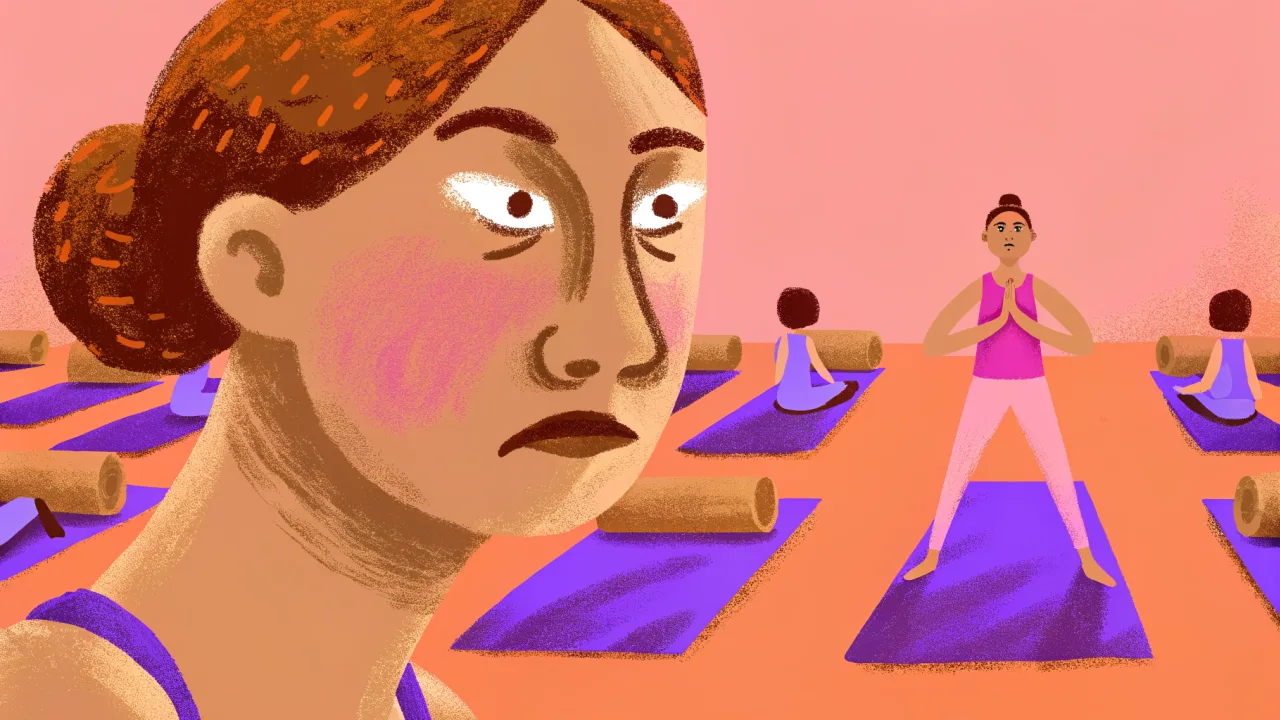
Picture this: you're in a yoga class, settled into a comfortable seat, and the teacher asks you to "direct your prana" or "bring awareness to your heart chakra." Part of you is genuinely curious; you want that glowing, full-body aliveness that seasoned practitioners always seem to be talking about. But another part of you, your very logical, very modern brain, immediately throws up its hands. Because if you can't see it, measure it, or graph it in a lab, how are you supposed to know it's even real, right?
This is one of the most common tensions people bring to their yoga or meditation practice, and it's worth talking about. I know that many of my 200 hour YTT students over the years have asked me if they have to "believe" in subtle energy since they tend more towards the materialist perspective. But the good news is that you genuinely don't have to choose between being a rational thinker and having a rich inner experience on the mat.
Learning to hear the background vocals
When I think about learning to tune into my own subtle energy, I like to think about hearing a song I really love for the first time. At first, the song is just a wall of sound coming at you all at once. But the more you listen, the more the layers start to separate. On the second listen, you catch the bass line. On the third listen, you appreciate the rhythm of the drums. And eventually, those faint background vocals you almost missed entirely shine through and the song becomes this multi-layered piece of art. These different layers create a full picture, but it's only when you try to experience them layer by layer rather than as a whole wall of noise, that you realize all the interwoven pieces of the puzzle. And this new attention you bring to the song makes it come to life even more. Makes it so much richer and more beautiful.
Developing energy awareness works in much the same way. The sensations are already present in your body right now, it's just that your attention hasn't been fully calibrated to their frequencies yet. For many yoga students, this might be due to resistance to the idea of energy. And for others, it might be that the brain and nervous system haven't learned to quiet down enough to let those softer layers come through.
The measurement problem (and why it's not the whole story)
One of the biggest sticking points for rational thinkers is this: ancient yogic texts describe thousands of energy pathways running through the body (nadis), and yet, no matter how carefully scientists look, they can't find them under a microscope or on an MRI scan. So what do we do with that?
A useful comparison is trying to find love with a scalpel. Can you find love on a chest MRI? Can you hold love in your hands? You can map every inch of the brain and the body and never extract a thought or a feeling as a physical object. But that doesn't mean those things aren't real. It means our instruments have limits. The absence of something in a scan is not the same as proof that it doesn't exist. The better question might not be whether we can measure subtle energy, but whether our current tools are sophisticated enough to look for it in the right places.
What the science says, and what it doesn't
So, can we actually see energy or energy centers? Can we measure them? The science is more interesting than you might think. And it might just be the thing that helps you break through any resistance you have to subtle energy, and actually try it for yourself. Remember, yoga has never been a doctrine. It has always been a 'try it and see' kind of philosophy. If you're too skeptical to even try, you'll never know what you're missing. So let's look at a few examples of how scientists from various fields are exploring this territory.
Are the chakras real?
So, when it comes to the chakras, researchers have noted a distinct relationship between the locations of some of the major chakras along the spine and the locations of major nerve clusters, called plexuses, identified by Western anatomy.
Around the location of the heart chakra sits the cardiac plexus.
The celiac plexus is located near the solar plexus, or solar chakra.
The hypogastric plexus is in the pelvic region, corresponding to both the sacral and root chakras. [1,2]
A 2017 cadaveric study published in the Ayurvedic journal Ayu, indexed on PubMed, went further, concluding that the root chakra (Muladhara) is anatomically represented by the inferior hypogastric plexus, with both sharing a triangular structure.[3]
That said, it's worth being honest about what this correspondence does and doesn't tell us. Joseph Loizzo, Assistant Professor of Clinical Psychiatry at Weill Cornell Medical College, has proposed cross-referencing chakra maps with central nervous system anatomy, but has also stated plainly that scientists cannot yet empirically assess this theory, because the technology to do so is still lacking.[4]
In other words, the overlap is real and worth paying attention to, but it hasn't been proven in the way a clinical trial would prove something. What we can say is that when ancient practitioners sat in meditation and identified areas of energetic significance along the spine, aka chakras, they were pointing to the same geography that Western anatomy would later map with dissection and modern imaging.
Here's a small but fun footnote on the history of how chakras look in the modern Western imagination: the rainbow color system (red for the root, orange for the sacral, and so on up through violet at the crown) is not ancient! It was introduced by the theosophist Charles Leadbeater in his 1927 book The Chakras [8].
Also, the full package of psychological attributes we now associate with each center (creativity, self-esteem, love, and the rest) was largely assembled in the late 20th century, shaped in part by Jungian psychology and the human potential movement. The original Sanskrit tantric texts talking about the chakras are considerably more basic, and are concerned primarily with practices, locations of energy wheels, seed mantras, and the movement of energy up through the subtle body.
So if you are all about the chakras as expalanations for emotional issues, or as a way to explain personality archetypes or emotional healing, please cite Jung and Western psychology, not "ancient yoga philosophy." :) And also - this isn't to say you should dismiss the modern system altogether, which many people find genuinely useful, but it's worth knowing where it came from so we're not telling people that the ancient mystics were talking about fear and survival at the root chakra. They weren't :).
Your aura is purple...prana, chi and biomagnetic fields
Back to the science.
Biophysicist James Oschman, author of Energy Medicine: The Scientific Basis, suggests that what ancient traditions called prana or qi may correspond to the bioelectric and magnetic fields that modern instruments can now actually measure. And this electromagnetic field is probably something you've felt before, in the form of your heart beat or even strong energy radiating from your heart. Your heart is the most powerful source of electromagnetic energy in your body, producing an electrical field about 60 times stronger than your brain's. [5] [6]
The heart's magnetic field extends several feet outside the body and can be detected at a distance. This electromagnetic energy might just be the same thing as the subtle energy the yogis have been talking about for ages. Why not..? And the body's electromagnetic activity doesn't stop at fields and currents radiating from the heart and brain. Right down at the cellular level, something equally strange and measurable is going on, which we'll explore in the next section.
But first, quickly - In his studies, Oschman discovered something that might make you feel better about those days when you feel nothing at all in class: people vary a lot in how sensitive they are to these kinds of energetic signals. It may not be purely about focus or belief, even. Some people simply seem to pick up on subtler input than others. Which is worth keeping in mind the next time you're lying in Savasana, wondering why the person next to you looks like they're having a spiritual awakening while you're thinking about what to make for dinner. I see you, you're welcome :).
Beings of light. Literally.
Across traditions and centuries, people have described advanced practitioners as somehow radiant; gurus who seem to glow, teachers who light up a room in a way you can't quite explain. One traditional interpretation of the word Guru is one who leads from darkness to light.
Well, the German biophysicist Fritz-Albert Popp spent decades looking into something that makes all of these yogic light analogies a little less poetic, and a little more real. He found that every living cell emits tiny pulses of light, called biophotons, constantly and spontaneously. So, you are actually full of light, even if you can't see it with the naked eye.
And in healthy people, these light emissions coming from your cells are highly coherent, meaning the light particles are synchronized with one another, almost like an orchestra playing in tune.
In diseased or stressed cells, however, that coherence breaks down. The light becomes chaotic or weak. He also found that stress causes biophoton emissions to spike, as though the body is trying to restore its own equilibrium. So we might infer that a glowing yogi or seasoned meditator is radiating highly coherent, focused light from their cells. And on the other hand, someone who is highly stressed, or in need of healing and repair, is also glowing, but the light is scattered and incoherent.
Now, nobody is claiming that a seasoned meditator is literally glowing in a way that you could photograph. But I know some of you yogis out there have felt like you radiate after yoga class (I know this because you've told me! 🙌🏽)
So when you do walk out of a yoga class feeling clearer and more alive than when you walked in, Popp's research suggests something real may have shifted in you, literally at the cellular level. Not just in your mood...not just the feeling of a warm "yoga buzz," but in the coherence of your body's own internal light [7]. It's amazing, isn't it?! I love to give cues about feeling this and that effect of yoga "on the cellular level." It's reassuring to me that there may just be some weight to what I'm saying.... ;)
I saved the best for last - you are a particle and a wave
In quantum physics, there is a famous experiment called the double slit experiment, which has been repeated hundreds of times with consistent results, and which scientists themselves describe as one of the strangest things in all of science.
Here's the simplified version: when researchers fire tiny particles of light (called photons) at a screen with two small slits in it, something unexpected happens. When nobody is measuring which slit each photon goes through, the photons act like waves. A wave, in this context, isn't a thing - it's a pattern of spreading energy, like ripples moving outward from a stone dropped in water. So a wave of energy.
The photons spread out and overlap with themselves, creating a shimmering interference pattern on the other side of the screen.
But the moment a measuring device is introduced...aka the moment information is gathered about which slit each photon passes through...the energy wave pattern completely disappears. The photons suddenly behave like ordinary little particles instead, landing in two neat lines behind the two slits. They change from wave-like energy, into particulate matter.
These are the exact same photons. But the simple act of measuring them, of observing them, makes them behave totally differently. Just based on whether they are being measured or not. The act of measurement itself changes what the particle (or the wave) does.
What this means is that at the most fundamental level of reality, energy doesn't exist as a fixed, solid thing until it is in some way interacted with. It exists as a field of possibility. A wave of potential. And you - your body, your cells, your breath - are made of exactly this same stuff. So when you close your eyes in class and bring your attention inward, you are not doing nothing. You are an observer, interacting with your own field of energy. And if quantum physics has taught us anything, it's that observation changes things [9]. Maybe attention isn't as passive as we think. Maybe our awareness of the energy is what makes it tangible and measurable after all.
Feel your energy - the food critic approach
How do you actually start exploring subtle energy without forcing yourself to believe something that feels challenging, or shutting the whole experience down before it gets started? Approach your own body the way a seasoned food critic approaches an unfamiliar dish. They don't sit down and demand that the food taste like something they already know. They take a bite, stay curious, and just notice what's actually there - a little acidity up front, something earthy in the middle, a warmth at the end. Gathering data without rushing to a verdict.
I remember the first time I went to a fancy restaurant with a sommelier. Based on my dinner choice, he recommended a wine and explained it would pair beautifully with my dish, as it had notes of - I kid you not - pencil shavings. Pencil shavings! I burst out laughing. It didn't taste like pencil shavings to me. It tasted like wine.
Your yoga teacher might try to describe how subtle energy feels, just like that sommelier. But it might not taste that way to you at all. So just be open. Notice what's actually there for you, cos that's what matters.
On the mat, this looks like noticing sensations without immediately labeling them as 'energy' or dismissing them as 'just a muscle stretch.' You're not trying to prove or disprove anything. Just pay attention and stay open to what shows up.
Start with the loud stuff
When you're new to this kind of internal observation, it helps to begin with the areas of your body that are already broadcasting the strongest signals: your hands, feet, and face. These areas have far more nerve endings than, say, your mid-back, which means there's simply more sensation available to notice. Trying to feel subtle energy in your back when you're just starting out is a bit like trying to make out details in a blurry, pixelated photo, whereas your hands are more like a crisp 4K image. There's just a lot more to work with.
From there, you can start tracking what's already obvious, like your heartbeat, or warmth moving through your palms, or the tingling rush that comes when you lower your legs from the wall after legs-up-the-wall. This is energy awareness. Prana is a felt sense of vitality, the quality of aliveness you feel when everything is flowing well.
What if you feel nothing at all?
Imagine standing in the middle of a brightly lit city at midnight and looking up at the sky. You won't see a single star. It's not because there are no stars above cities, it's because all the artificial light is drowning them out. Drive out to a dark field in the countryside and suddenly the sky is packed with thousands of them.
Your inner experience works the same way. When your nervous system is flooded with stress, caffeine, or a racing mind, the subtle signals simply can't compete. The noise floor is too high. The stars are still there, but the conditions just aren't right yet.
Slow, deliberate breathing (especially long exhales) is one of the most reliable ways to bring that noise floor down. It directly activates the part of your nervous system responsible for rest and recovery, and as things settle, more of your quiet, subtle energy becomes perceptible.
In conclusion
Subtle energy may be one of those things that science is still catching up to. The yogis, the meditators, the mystics, they've been running their own experiments for thousands of years, in the laboratory of the human body. And what they found is now starting to show up in peer-reviewed journals and physics textbooks in ways that would probably make them smile.
You don't have to believe in any of it to begin. You just have to be willing to pay attention; carefully, curiously, without deciding in advance what you're going to find. And don't be fooled - doing that is not just mysticism. It's actually just good science.
So the next time your teacher asks you to feel into your heart chakra, or to notice the prana moving through your hands, try approaching it the way you now know to approach anything worth understanding. Get curious. Stay open. And see what's already there, waiting to be heard at the deepest layers of your being.
Be well, you radiant being of light 💜💡
Sources & further reading
Creative Soul Therapies — "The Chakras and the Nervous System" (2018): overview of cardiac, celiac, and hypogastric plexus correspondences. creativesoultherapies.com
Journal of Pharmaceutical Negative Results (2023) — "Neuro-anatomical and Physiological Study on Sada Chakra": peer-reviewed overview of plexus and endocrine correspondences with chakra locations. pnrjournal.com
Sweta et al. (2017) — "Physio-anatomical resemblance of inferior hypogastric plexus with Muladhara Chakra: A cadaveric study." Ayu, 38(1-2), 7. PubMed Central
YogaUOnline — "7 Chakras: What Science Says About Yoga's Energy Centers": summary of Loizzo's CNS mapping work and its limitations. yogauonline.com
Oschman, J.L. — Energy Medicine: The Scientific Basis. Churchill Livingstone, 2000 (2nd ed. 2015).
McCraty, R. — Science of the Heart, HeartMath Institute. Available at: heartmath.org/research/science-of-the-heart
Popp, F.A. — "Properties of biophotons and their theoretical implications." Indian Journal of Experimental Biology, 41(5), 391-402, 2003. PubMed indexed.
Leadbeater, C.W. — The Chakras. Theosophical Publishing House, 1927 & Wikipedia — "Chakra": history of Leadbeater's 1927 color system and the later assembly of psychological attributes. wikipedia.org
Feynman, R.P. — The Feynman Lectures on Physics, Vol. 3, Chapter 1. Available free at feynmanlectures.caltech.edu