Takeaways
It’s always an option. Rest in Child’s Pose whenever you need a pause, in any class.
Your bones choose your knee width. Wide or close, whatever feels comfortable for your hips is right.
Let the hips sink to lengthen the spine. If they hover above your heels, sit on a block or a bolster instead of pushing.
Support your head. A block, your stacked hands or your fists keep your forehead from hanging in the air.
Props turn it restorative. Hug a bolster before Savasana, or try Embryo Pose for the upper back.
Child’s Pose at a glance
Sanskrit: Balasana (bala = child, asana = pose)
Also called: Child’s, Bala Asana
Pose type: kneeling forward fold and resting pose, from active Hatha to Yin and restorative
Stretches: the hips and outer glutes, the low back, the shoulders (with the arms forward), the fronts of the thighs, ankles and feet
Works: in the active version, the hands and the backs and sides of the arms; in the quiet versions, nothing has to work at all
Props that help: a blanket, one or two blocks, a bolster
The pose you’re always allowed to take
If you’ve ever done Child’s Pose, you know how calming it is. You may even have fallen asleep in it. There have been multiple times when I nearly nodded off in Child’s Pose while teaching.
The pose got its name from its shape. When you fold into it, you look like a small child curled up in bed, or a baby in the womb. Very obvious why we call it Child’s Pose.
Whenever you need a pause, Child’s Pose is always an option.
It’s also the pose you can come back to at any point in a class. Many of us only rest when a teacher reminds us that it’s allowed, so consider this your reminder: it’s never the wrong choice.
Why Child’s Pose calms you down
Feel the front of your body for a moment. It’s soft and quite vulnerable. Apart from the heart and the lungs, most of our organs, especially the digestive organs, have no protection from the skeleton at all. The back of the body is a different story. When you round forward and curl in on yourself, there isn’t much that can be damaged.
I know that sounds a bit animalistic, but our nervous system still works the way it did thousands of years ago, when this made a real difference. Think of a dog. When a dog is scared, it curls its tail under, crouches down and protects its belly. When a dog is happy, it rolls onto its back with its legs wide, all “scratch my belly,” showing you its most vulnerable parts.
Child’s Pose, like any forward fold where you round your back and curl in, puts you in that place of protection and safety. That’s what lets your nervous system slow down and relax. Notice it the next time you’re there.
One pose, from active to restful
Child’s Pose is a crossover pose. It fits into a Hatha or vinyasa class, a Yin class and a restorative practice, and what changes is how much you activate your muscles and how long you stay. In a flow you might hold it for a few breaths with active arms. In Yin you might stay for five or even ten minutes. Add bolsters and blankets, and it becomes a restorative pose. (This idea of the same shape having different effects runs through a lot of yoga.)
How to come into Child’s Pose
Come down to kneel and sit back on your heels, with the tops of your feet on the floor.
Take your knees apart, as wide or as close as feels comfortable for your hips.
Walk your hands forward and lower your torso down onto or between your thighs.
Rest your forehead on the mat, or on a block or your hands if the floor is far away.
Let your hips settle back toward your heels as far as they go.
Breathe into the back of your body. Close your eyes if you like.

Child’s Pose: hips settling back, forehead down, the whole back in one long curve.
To come out, walk your hands back toward your knees and roll up to sit on your heels, or press back into tabletop or Downward-Facing Dog when you’re ready to move again.
Setting up your Child’s Pose
Knee width
How wide your knees go depends on your bone structure: the shape and proportions of your hips and your thigh bones. Some people want their knees really wide, and for others that doesn’t feel comfortable at all, so they keep the knees closer together. Neither is better. Find what feels good for you.
Your knees also change the shape of your spine. With your thighs right under your belly and chest, your back rounds as it folds over your legs. With your knees out to the sides, your belly can drop between your thighs and your spine looks more neutral. Neither one is right or wrong.
If you have a bigger body, a large chest or a baby on board, the knees together can squash your belly against your thighs. Many people naturally want to take their knees out wide, and that’s a perfectly good choice.
Your hips and spine
Child’s Pose puts your spine in what’s called the primary curve. That’s spinal flexion, the curve we had in the womb, and it’s a lovely way to lengthen the spine. Notice your tailbone curling under and all the space from your tailbone out to the crown of your head. What you’re going for is a little traction: the bones of the spine gently separating as your back grows long.
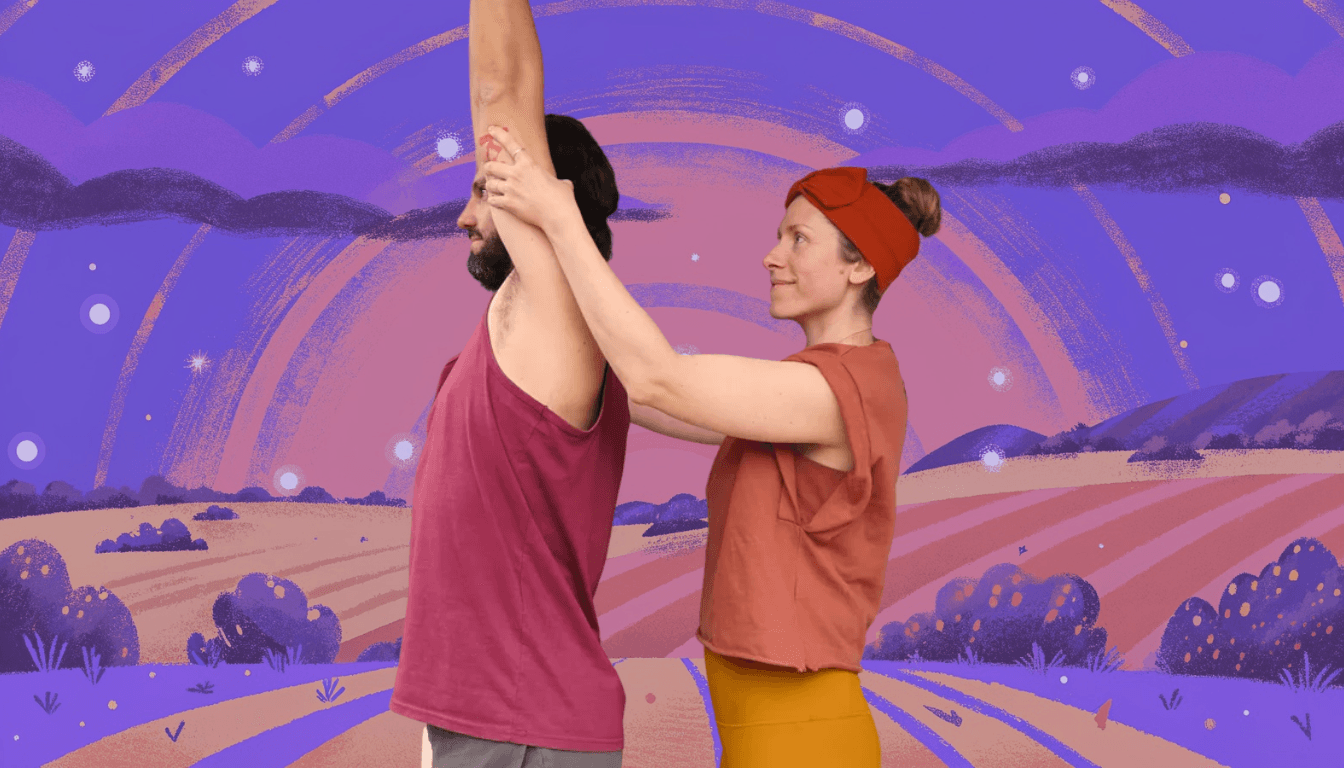
The way to get there is to let your hips relax down as far as they go. Maybe a teacher has pressed your hips down gently with the heels of their hands in a class. That’s the same idea: the hips sink, the spine lengthens.
Let your hips sink, and your spine gets longer.
If your hips stay high above your heels, you’re in good company. It’s very common, and it usually comes from limited bending in the knees or in the hip joints, or simply from being tight enough that it’s uncomfortable. Hovering in the air like that isn’t restful, so give your hips something to sit on (more on that below).
Your forehead
Your forehead rests down on the mat. A lot of people say this is a nice gentle stimulation for the third eye. I personally haven’t had any insights or cosmic experiences by pressing my forehead to the mat, but maybe you have, and I don’t want to discount that.
What matters is that your head is supported. If your head is hanging in the air, the pose isn’t very restful, so bring the floor up to your forehead with a block or your hands.
Active arms
For a more active Child’s Pose, reach your arms forward and spread your fingers really wide. Press evenly through your hands (we call this Hasta Bandha) and lift your elbows off the mat to engage the backs and sides of your arms. This gently warms up the shoulder girdle, which is useful when something stronger like Downward-Facing Dog comes next.
With your arms forward, your shoulders are in deep flexion, roughly in line with your ears. For many people that’s quite an intense stretch, so let your arms rest instead whenever you want a quieter pose.
What Child’s Pose stretches
There’s a lot going on in the big joints of your legs. Your hips are flexed and your thighs move away from the midline. Your knees bend almost all the way, and your ankles point straight back. These are deep movements we aren’t used to. Even sitting in a chair, your knees are usually at about 90 degrees, and when you walk and stand, your ankle sits at about 90 degrees too. So it’s no surprise if your knees, ankles or feet speak up.
You’ll probably feel the stretch in your hips and outer glutes. Many people feel it in the low back, where the muscles and especially the fascia get a really big opening. And many feel it in the shoulders when the arms are forward.
Modifications, variations and alternatives
A modification keeps the pose and changes the support. A variation keeps the pose and adds something. An alternative is a different pose with a similar effect.
There’s a short film about Embryo Pose if you want to sink into one of the variations.
Common mistakes and how to fix them
Your hips hover above your heels
Looks like: your hips stay high in the air and your legs work to hold you there.
Try: sit on a block between your ankles or a bolster on your heels. Don’t push your hips down; let them relax as far as they go.
Your head hangs in the air
Looks like: your forehead doesn’t reach the floor and your neck holds the weight of your head.
Try: rest your forehead on a block, your stacked hands or your stacked fists.
Squeezing your knees together
Looks like: you keep your knees together because that’s how you learned it, and your hips or belly complain.
Try: take your knees as wide or as close as feels comfortable for your hips. If you feel squashed or struggle, try the other option.
Your knees, shins or feet hurt on the floor
Looks like: pressure on the knees or on the tops of the feet, or ankles that won’t point straight back.
Try: a blanket under your knees and feet, and a small blanket roll under the fronts of your ankles.
Child’s Pose doesn’t feel restful
Looks like: your belly or chest feels squashed and the breath gets short, or with your knees wide and your arms back, you feel too much pressure on your head.
Try: bring your knees together so your torso rests on your thighs, or widen them, whichever feels better. Hug a bolster, or switch to Heart-Melting Pose on a block. Child’s Pose isn’t restful for every body on every day, and that’s okay.
Who should be careful
Shoulder injury. With your arms forward, the shoulder is in full flexion. Stack your fists under your forehead so your arms come down to a lower angle.
Pregnancy. Folding forward can press the belly against the thighs. Take your knees wider than normal and rest your forehead on a block, so you lift up away from the ground and the belly doesn’t touch the mat. There’s more on why prenatal yoga is different in its own lesson.
Knees and ankles. This much bending in the knees and pointing in the ankles is unusual for most of us. Pad the knees and feet, use the ankle roll, and come out if it doesn’t feel good.
When to use Child’s Pose in your practice
Any time in a flow (instead of a vinyasa or Downward-Facing Dog).
After deep hip and hamstring stretches. Bending your knees reverses the stretch and tells your nervous system that the effort is over.
After backbends (to stretch out the low belly).
After inversions.
Related poses
Embryo Pose (same shape with the knees together and the arms back)
Heart-Melting Pose (halfway between tabletop and Child’s Pose)
Thread the Needle Pose (gentle twist you can slide into straight from Child’s Pose)
Rabbit Pose (a different pose you enter from Child’s Pose, with the crown of the head down and the hands holding the heels)