Badge

Jess Rose
Perfection isn't the point
You've probably heard that ahimsa means non-violence or non-harming.
What's the first example of non-harming that comes to your mind?
If you're like 99% of yoga students, your thoughts jumped straight to "meat vs. no meat".
Do you eat meat (causing harm to animals), or not..?
This is an interesting discussion to have, and it comes up almost every couple of weeks in the Movement Wisdom Yoga Teacher Training.
But a lot of my students are surprised to learn that there's more to ahimsa than just being a vegetarian or not.
More ways to practice ahimsa
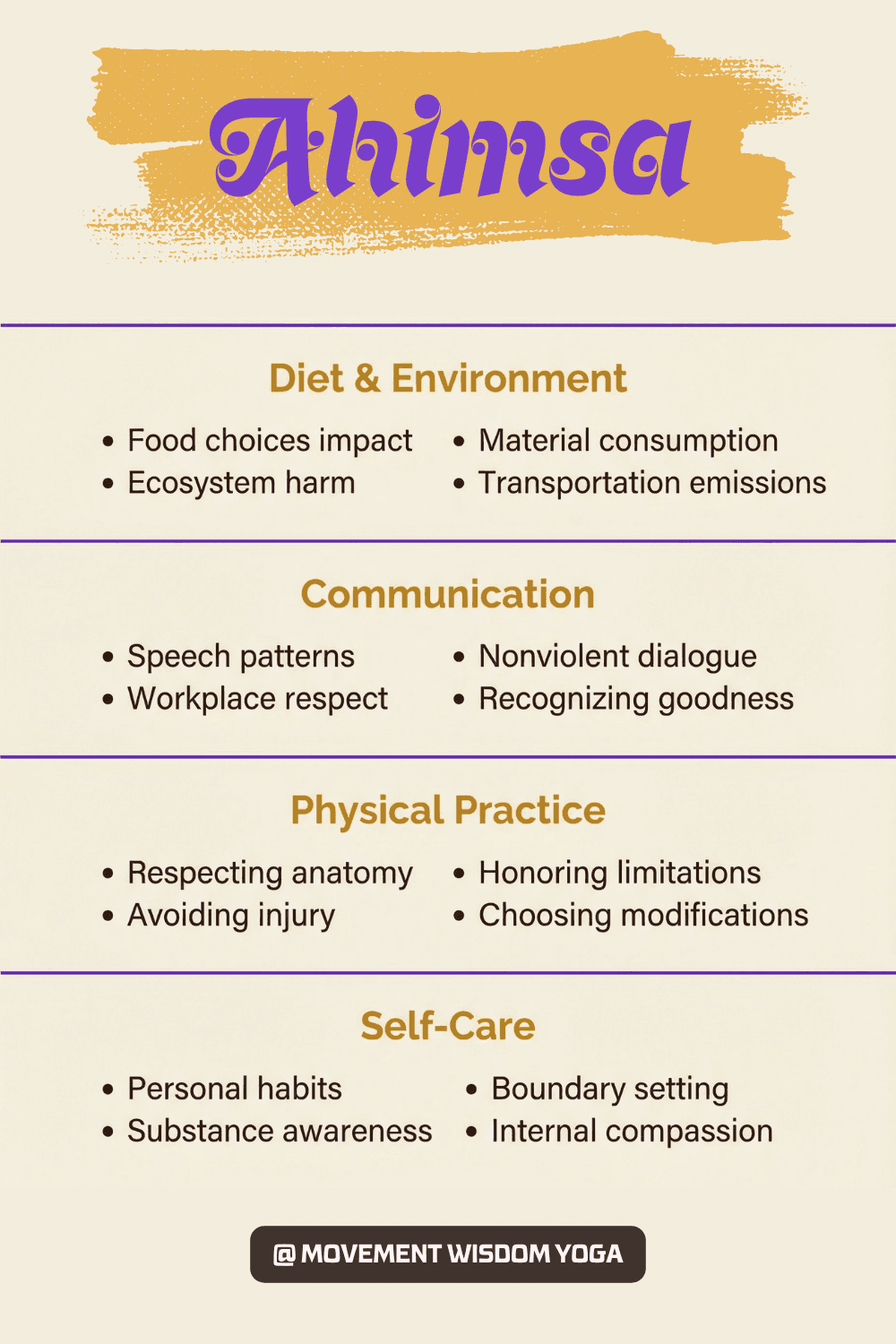
There are many ways to practice ahimsa in your life and on the yoga mat.
How you talk to other people, for example..? Especially people who push your buttons, or those who you might take for granted?
How do you talk to yourself..?
Are you able to swallow the hurtful comments that are on the tip of your tongue or that you say to yourself on repeat?
And how do you treat yourself? Do you take care of yourself? Do you have habits that you know to be harmful?
Do you push yourself to the point of injury in your yoga practice? Or do you respect your limitations?
Ahimsa, if you let it, extends to all aspects of life, not just what's on your plate.
It's not about being perfect
The other important aspect of ahimsa that doesn't get enough attention is that, when Patanjali put it into the Yoga Sutras, he never said explicitly how to practice it.
Which means, that if you have ever crossed paths with anyone in the 'yoga police,' telling you that you are not practicing ahimsa with some of the actions in your life, just know that there are no set rules and definitions of ahimsa.
What feels like non-harming to me might not feel like non-harming to you.
And I think it's important to point out that living without harming other beings or the planet is straight up impossible.
Scientists now believe that plants are conscious ... with that in mind, what are we yogis supposed to eat without causing harm..?!
A gazillion creatures died or had to flee their home to build the house that you now live in.
We humans cause harm in so many ways, even when we don't try. Animals do it, too, though. Bacteria as well. It's just a part of nature, whether we like it or not.
I think ahimsa should be understood as conscious awareness.
As a practice of recognizing how we fit into nature, while doing our best to respect other creatures around us.
But knowing that there is no way to live without causing any harm.
And also - not policing others based on our own personal views of ahimsa is a very yogic stance to take, too.
The best way to bring ahimsa into your life might be to examine the consequences of your actions. To realize when you're causing harm and to look for ways to reduce (not eliminate) the damage that you cause.
The Takeaway
Ahimsa is one of the most commonly talked-about concepts from the Yoga Sutras. And in some yoga circles, there is a lot of 'ahimsa policing' and judging others' behavior going on. Non-harming is a broad practice, and is about awareness and intention in all areas of life - not just about vegetarianism. And although it would be amazing, none of us is able to live in a way that causes no harm to other creatures or the planet.
💜 Jess